
Personal Loan Vs Credit Card: Which One Actually Costs You Less?
 22
22  1
1  2
2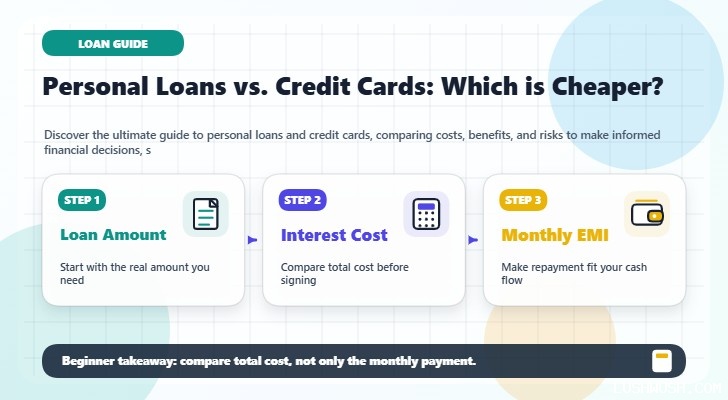
Personal Loan vs Credit Card: Which One Actually Costs You Less?
You need money. Maybe it's an unexpected medical bill, a home repair that can't wait, or a large purchase you want to spread out over time. Whatever the reason, you're looking at two options sitting in front of you: take out a personal loan or put it on a credit card.
Both get you the money. But they work very differently and choosing the wrong one can cost you thousands of rupees (or dollars) more than it needed to.
Let's break this down honestly.
How a Personal Loan Actually Works
A personal loan is straightforward. You apply for a fixed amount, the lender approves it and deposits the money, and you pay it back in equal monthly installments over an agreed period usually anywhere from 1 to 5 years.
The interest rate is fixed. That means your monthly payment stays the same from month one to the very last payment. No surprises, no fluctuations.
This structure is actually a feature, not a limitation. When you take a personal loan, you know exactly how much you owe, exactly what you'll pay each month, and exactly when it'll be over.
Personal loans typically charge interest rates between 10% and 24% annually, depending on your credit history and the lender. Some banks charge an upfront processing fee (usually 1-3% of the loan amount), so factor that in when comparing.
How a Credit Card Actually Works
A credit card gives you a spending limit say $5,000 or Rs. 1,00,000 and you can spend up to that amount whenever you want. You get a bill at the end of each month, and here's where it gets important: you can either pay the full balance or pay a minimum amount and carry the rest forward.
That flexibility sounds convenient. And it is right up until the moment it isn't.
Here's the catch: credit card interest rates are typically much higher than personal loans, often ranging from 24% to 42% annually. And interest isn't charged on the amount you originally spent it's charged on whatever balance you're carrying, recalculated every single month.
If you only make minimum payments, a $2,000 balance can take years to pay off and cost you nearly double in total interest. That's not a worst-case scenario that's a very common one.
The Real Comparison: What Does Each One Actually Cost?
Let's use real numbers so this isn't abstract.
Say you need Rs. 1,00,000 (or $1,000 same math, different currency).
With a Personal Loan at 14% interest over 2 years: Your monthly EMI would be roughly Rs. 4,800. Total paid back: around Rs. 1,15,000. Total interest paid: Rs. 15,000.
With a Credit Card at 36% annual interest, making minimum payments: You could easily end up paying Rs. 1,60,000 to Rs. 1,80,000 over time and that's if you're disciplined about payments. Miss a few months or only pay the minimum, and the number climbs higher.
Same amount borrowed. Potentially three times more in interest.
This is why the question "which is cheaper?" almost always has the same answer: for any significant amount that you can't pay off within one billing cycle, a personal loan is almost always the cheaper option.
So When Does a Credit Card Actually Make Sense?
Credit cards aren't bad. Used correctly, they're genuinely useful tools.
A credit card makes sense when you can pay the full balance before the due date. If you spend Rs. 20,000 this month and pay it off completely when the bill arrives, you've paid zero interest. You might even earn reward points or cashback in the process. That's a legitimate win.
Credit cards are also useful for smaller, everyday purchases groceries, fuel, subscriptions where you know you have the money and you're just using the card for convenience and rewards.
Where credit cards become expensive is when you start carrying a balance. The moment you don't pay the full amount and start paying interest, the rate kicks in and at 36-42%, it kicks in hard.
When a Personal Loan Makes More Sense
Choose a personal loan when:
The amount is significant. Anything above what you can comfortably pay off in one or two billing cycles is better handled as a structured loan with fixed payments.
You want predictability. A fixed EMI lets you plan your monthly budget without worrying about fluctuating balances or changing interest calculations.
You're consolidating credit card debt. This is actually one of the smartest uses of a personal loan. If you're carrying Rs. 2,00,000 across multiple credit cards at 36% interest, taking a personal loan at 14% to pay them all off in one shot saves you an enormous amount in interest. You go from chaotic to structured, and cheaper.
You're making a large one-time purchase. Medical expenses, education, home repairs, a wedding for big planned expenses, a personal loan gives you a clear repayment path.
The One Thing Most People Get Wrong
Most people compare personal loans and credit cards based on monthly payment size. "The credit card minimum payment is lower than the EMI, so the credit card is easier."
That thinking is the trap.
A lower minimum payment doesn't mean it's cheaper. It usually means you're paying less of the principal and more of the interest, and you're stretching the repayment over a longer period. The total cost the actual number that matters is almost always higher with a credit card when you carry a balance.
Always compare total repayment amounts, not monthly payments.
Before You Borrow, Run the Numbers
Whatever you decide personal loan or credit card it's worth seeing the actual breakdown before you commit. How much will you pay in total? How much goes to interest versus principal? How does the tenure affect the total cost?
Our free calculator shows you the full picture instantly:
Calculate Your EMI and Total Interest with the Smart EMI & Interest Calculator
Put in the loan amount, interest rate, and tenure and you'll see exactly what you're signing up for before you sign anything.
The Short Answer: Use a credit card for everyday spending you can pay off in full each month. Use a personal loan for any significant amount you'll need time to repay. And whatever you borrow, always know the total cost not just the monthly payment.




















All comments, feedback, information or materials except email addresses submitted to Lush Wush shall be considered non-confidential and its property. By submitting such comments, feedback, information or materials to us, you agree to a no-charge assignment of all worldwide rights. For the best interest of the community, please refrain from posting vulgar comments, profanity, or personal attacks. Comments submitted may automatically be flagged for review by our moderation team before appearing on the website.