
The 50/30/20 Budget Rule: How To Save Money Without Feeling Broke (part 1)
 73
73  1
1  8
8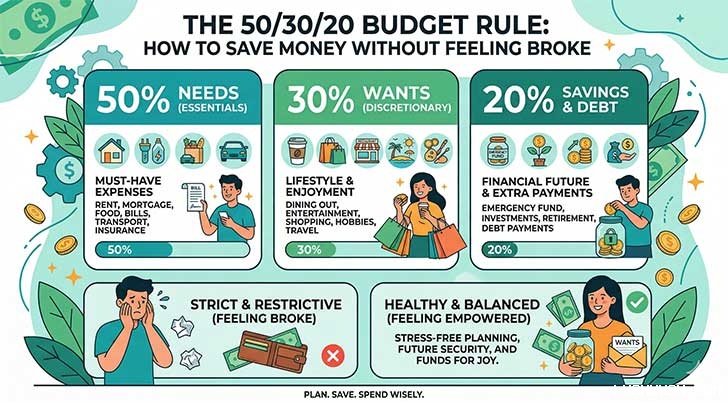

The 50/30/20 Budget Rule: How to Save Money Without Feeling Broke (Part 1)
We have all been there. Your paycheck arrives, you feel great for about three days, and then suddenly, you find yourself staring at your bank account wondering, "Where did all my money go?" Saving money often feels like going on a strict diet. It feels restrictive, boring, and almost impossible to stick to. But what if I told you that building a solid savings account doesn't mean you have to stop enjoying your life?
Welcome to Part 1 of our Smart Savings series. Today, we are going to look at one of the most effective and easiest money-management strategies in the world: The 50/30/20 Rule.
What is the 50/30/20 Rule?
Forget complex spreadsheets and stressful daily tracking. The 50/30/20 rule is a simple percentage-based system that divides your monthly after-tax income into exactly three clean categories: Needs, Wants, and Savings.
Let's break down how it actually works.
1. The 50%: Your Absolute Needs
Half of your income should be dedicated to the things you absolutely must pay for to survive. These are non-negotiable expenses.
Rent or mortgage payments
Basic groceries
Utility bills (electricity, water, internet)
Minimum loan or credit card payments
Health insurance and essential medications
If your "Needs" are taking up more than 50% of your income, it might be time to look for ways to cut back on those fixed costs, like finding a cheaper internet plan or meal-prepping to reduce the grocery bill.
2. The 30%: Your Wants (The Fun Stuff)
Yes, you read that right. A whole 30% of your money is strictly for enjoying your life! This is why this budgeting rule actually worksit doesn't punish you for being human.
Dining out at restaurants or ordering takeout
Buying that new pair of shoes you have been eyeing
Movie tickets, concert passes, or Netflix subscriptions
Vacations and travel expenses
By putting a strict 30% cap on your "Wants," you can spend your money guilt-free. You know exactly how much fun money you have for the month, which stops you from accidentally spending your rent money on a shopping spree.
3. The 20%: Savings and Investments
This is the golden slice of the pie that builds your future. As soon as you get paid, 20% of your income should immediately be moved away from your main spending account.
Emergency Fund: Saving up cash for unexpected car repairs or medical bills.
Investments: Putting money into digital or physical gold, the stock market, or mutual funds (which we cover in our other series!).
Debt Payoff: Making extra payments to clear high-interest debt faster.
Pro Tip: Automate this step! Set up your banking app to automatically transfer 20% of your paycheck into a separate savings account the exact day you get paid. If you don't see it in your main account, you won't be tempted to spend it.
Your First Action Step
Personal finance is exactly thatpersonal. The 50/30/20 rule is a fantastic framework, but it is okay if you need to adjust it slightly to fit your life (like 60/20/20 if you live in a very expensive city).
The goal isn't to be perfect; the goal is to finally take control of where your money goes.
Take a look at your last month's bank statement. Can you figure out what percentage of your money went to your "Wants"? Let me know if the number surprises you in the comments below!















All comments, feedback, information or materials except email addresses submitted to Lush Wush shall be considered non-confidential and its property. By submitting such comments, feedback, information or materials to us, you agree to a no-charge assignment of all worldwide rights. For the best interest of the community, please refrain from posting vulgar comments, profanity, or personal attacks. Comments submitted may automatically be flagged for review by our moderation team before appearing on the website.