
The Magic Of Compound Interest: How Your Money Makes Money (part 3)
 88
88  1
1  12
12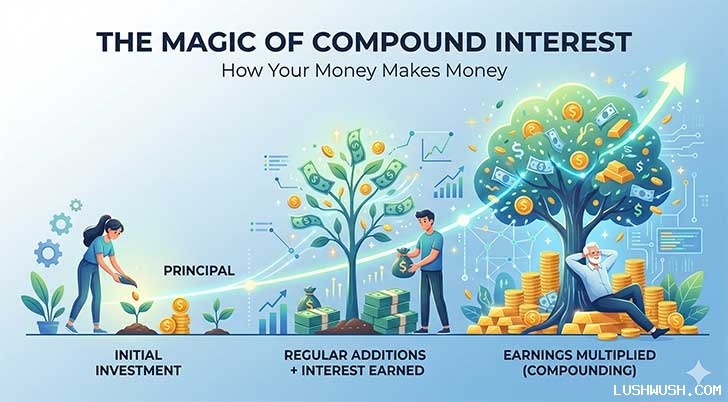
The Magic of Compound Interest: How Your Money Makes Money While You Sleep (Part 3)
There's a moment that happens to most people when they first truly understand compound interest. Not just intellectually but viscerally, in a way that changes how they think about money and time.
It usually happens when they look at a projection table for the first time and realize: someone investing $200 a month starting at 22 years old ends up with more money at retirement than someone investing $1,000 a month starting at 40 despite contributing a fraction of the total dollars. The earlier investor wins not because they earned more or saved more aggressively, but because time did the work for them.
That's the thing about compound interest. It rewards patience and punishes delay in ways that feel almost unfair until you're on the right side of it.
This is Part 3 of our Investments series, the final piece of the foundation. In Part 1, we established why investing is essential and what your options are. In Part 2, we made the case for index funds as the smartest starting point for most beginners. Today we're going deep on the mathematical engine that makes all of it work: compound interest.
Simple Interest vs. Compound Interest: Understanding the Difference
Before we get into the power of compounding, it helps to understand what it's being compared to: simple interest.
Simple interest is calculated only on your original principal the amount you initially invested. Nothing more. If you invest $1,000 at 10% simple interest:
- Year 1: Earn $100 Total: $1,100
- Year 2: Earn $100 Total: $1,200
- Year 3: Earn $100 Total: $1,300
- Year 10: Total: $2,000
You earn $100 every single year because you're always earning interest on the same original $1,000. Linear growth. Predictable, but limited.
Compound interest is different. You earn interest on your principal and on all the interest you've already earned. The base keeps growing, so each year's interest payment is larger than the last.
Same $1,000 at 10% compound interest:
- Year 1: Earn $100 Total: $1,100
- Year 2: Earn $110 (10% of $1,100) Total: $1,210
- Year 3: Earn $121 (10% of $1,210) Total: $1,331
- Year 10: Total: $2,594
Instead of $2,000, you end up with $2,594 and the gap between simple and compound interest grows dramatically over longer time periods. By year 30, simple interest gives you $4,000. Compound interest at the same rate gives you $17,449.
That difference $13,449 on the same $1,000 starting investment comes entirely from the structure of compounding. You didn't earn it. Time did.
The Snowball You Can't Stop
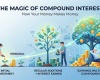
The most intuitive way to understand compounding is the snowball analogy. You pack a small snowball and roll it down a long hill. In the first few feet, it barely grows the snowball is small, so each rotation only picks up a thin layer of new snow. But as it gets larger, each rotation covers more surface area, picks up more snow, and the growth accelerates. By the bottom of the hill, what started as a golf ball is now the size of a boulder.
Your money works exactly like this.
In the early years of investing, compounding feels underwhelming. You invest $200 a month and after year two, your account is worth maybe $5,100 only slightly more than what you put in. It's easy to feel like the math isn't working.
But you're in the early part of the hill. The snowball is still small. Keep rolling.
Here's what $200 per month invested at 8% annual return actually looks like over time:
Years InvestedTotal ContributedAccount ValueProfit from Compounding5 years$12,000$14,694$2,69410 years$24,000$36,590$12,59015 years$36,000$69,636$33,63620 years$48,000$118,589$70,58925 years$60,000$190,150$130,15030 years$72,000$298,072$226,072
Notice what happens in the final decade. Between year 20 and year 30, your account grows from $118,589 to $298,072 an increase of nearly $180,000 even though you only contributed an additional $24,000 during that period. The compounding is doing $156,000 of the work for you.
This is why experienced investors say the hardest part of building wealth isn't finding the right investments. It's having the patience to leave money alone long enough for compounding to accelerate.
The Most Expensive Financial Mistake: Starting Late
The previous table shows what happens when you invest consistently. Now let's look at what delay actually costs because this is where the math becomes truly sobering.
Meet three investors. All of them earn the same income. All of them invest the same amount. The only difference is when they start:
Investor A The Early Starter Starts at age 22. Invests $300/month until age 32 (10 years only), then stops contributing entirely but leaves the money invested until retirement at 65. Total contributed: $36,000
Investor B The Late Starter Waits until age 32 to start. Invests $300/month consistently every single month until retirement at 65 (33 years of contributions). Total contributed: $118,800
Investor C The Very Late Starter Waits until age 42. Invests $300/month until retirement at 65 (23 years of contributions). Total contributed: $82,800
All three invest in the same index fund averaging 8% annual returns. Here's the result at age 65:
InvestorStartedTotal ContributedRetirement BalanceInvestor AAge 22$36,000$798,500Investor BAge 32$118,800$567,000Investor CAge 42$82,800$230,000
Investor A who contributed the least money and stopped after just 10 years ends up with significantly more than both other investors combined. Investor B contributed over $80,000 more than Investor A, invested for more than three times as long, and still came out with $231,500 less.
The only variable that explains this outcome is time. Specifically: Investor A gave compounding a 10-year head start that could never be overcome, no matter how much Investor B and C contributed later.
This is what "the best time to start was 10 years ago, the second best time is today" actually means in mathematical terms.
Compounding Frequency: How Often Does It Compound?
Not all compounding is created equal. The frequency at which your returns are reinvested affects how much you ultimately earn.
Annual compounding: Returns are reinvested once per year.
Monthly compounding: Returns are reinvested every month. Your January earnings start generating their own returns in February, March, April 11 months earlier than with annual compounding.
Daily compounding: Returns are reinvested every single day. Used by many high-yield savings accounts and money market instruments.
The difference in outcomes, while not as dramatic as the time horizon effect, is still meaningful over decades. A $10,000 investment at 8% annual interest:
- Compounded annually over 30 years: $100,627
- Compounded monthly over 30 years: $109,357
- Compounded daily over 30 years: $110,517
For stock market index funds, compounding happens continuously as the underlying companies earn profits and reinvest them making it effectively one of the most compounding-efficient investment vehicles available.
The Rule of 72: A Mental Math Shortcut
Here's a tool that makes compound interest tangible in a matter of seconds: the Rule of 72.
Divide 72 by your annual return rate. The result tells you approximately how many years it takes for your money to double.
Annual Return RateYears to Double (Rule of 72)4% (bonds/HYSA)18 years6% (conservative portfolio)12 years8% (balanced index fund)9 years10% (S&P 500 historical avg)7.2 years12% (aggressive growth)6 years
At the S&P 500's historical average of roughly 10%, your money doubles approximately every 7.2 years.
Start with $10,000 at age 25 and let it sit in an index fund:
- Age 32: $20,000
- Age 39: $40,000
- Age 46: $80,000
- Age 53: $160,000
- Age 60: $320,000
- Age 67: $640,000
That original $10,000 becomes $640,000 with zero additional contributions purely through the mechanical process of doubling every 7.2 years. No genius stock picking required. No financial expertise needed. Just patience and the refusal to sell.
The Three Enemies of Compound Interest
Understanding what compounding does is only half the equation. Understanding what destroys it is equally important.
Enemy 1: Fees
Every percentage point in annual fees is a percentage point of compounding that works against you instead of for you. As discussed in Part 2, the difference between a 0.03% expense ratio on an index fund and a 1.5% fee on an actively managed fund costs hundreds of thousands of dollars over a career of investing.
Fees don't just reduce your returns. They reduce the base on which future compounding is calculated. They're subtracted before the snowball rolls which means every dollar paid in fees is also all the compounding that dollar would have generated for decades.
Enemy 2: Taxes on Gains
Selling investments triggers capital gains taxes, which take a portion of your returns before they can be reinvested. Every tax bill paid is compounding interrupted.
This is one of the most powerful arguments for using tax-advantaged accounts 401(k)s, IRAs, and Roth accounts which either defer taxes until retirement or eliminate them entirely. The difference between investing in a taxable account and a Roth IRA at 8% over 30 years, assuming a 20% capital gains tax rate, is significant.
In a Roth IRA, your gains are completely tax-free at withdrawal. That means 100% of your compounded growth is yours to keep. That tax-free compounding, especially in the final high-growth decades, can represent hundreds of thousands of additional dollars.
Enemy 3: Panic Selling
The most dangerous enemy of compound interest isn't external it's behavioral. Selling during market downturns converts temporary paper losses into permanent real losses, permanently removes that capital from the compounding equation, and often results in buying back in later at a higher price (after missing the recovery).
Every major market crash in history 1929, 1987, 2000, 2008, 2020 was followed by a recovery and eventual new highs. Investors who held through every one of those crashes and did nothing came out significantly ahead of investors who sold in panic and tried to time their re-entry.
Compounding only works if you stay in the game. Volatility is the price of admission. The investors who pay it without flinching are the ones who eventually arrive at the destination.
How to Maximize Compounding: Practical Actions
Now that you understand how compounding works and what threatens it, here's how to position yourself to benefit from it as fully as possible.
Start today, regardless of amount. The compounding tables earlier in this article make one thing unmistakably clear: starting with a small amount now is dramatically better than waiting to start with a larger amount later. $50 per month at age 25 outperforms $500 per month at age 40 over a lifetime. Start now. Increase contributions as your income grows.
Reinvest all dividends. When your index funds pay dividends, reinvest them automatically rather than taking them as cash. Every dividend reinvested immediately begins compounding. Most brokerage accounts offer automatic dividend reinvestment (DRIP) turn it on and leave it on.
Use tax-advantaged accounts first. Before investing in a taxable brokerage account, max out any tax-advantaged options available to you. For most employees, this means contributing enough to your 401(k) to at least capture your employer's match (which is a 50100% instant return on that portion of your contribution). Then consider a Roth IRA for tax-free long-term compounding.
Keep fees as low as possible. Use low-cost index funds with expense ratios under 0.10%. Avoid actively managed funds with high fees. The compounding that fee money would have generated over decades is real wealth that goes to the fund company instead of your retirement account.
Don't touch it. The single most important compounding strategy is also the simplest: leave your investments alone. Don't sell during downturns. Don't withdraw early. Don't let short-term market noise interrupt a long-term compounding strategy. The investors who build the most wealth aren't the ones who make the cleverest moves they're the ones who make the fewest mistakes.
The Full Picture: Where You Are Now
Across this three-part series, you've built a complete investment foundation:
Part 1 established why investing matters, how inflation erodes cash savings, and what your main investment options are.
Part 2 made the evidence-based case for index funds as the most accessible, cost-efficient, and historically proven starting point for most investors with a clear framework for how individual stocks fit into a more advanced strategy.
Part 3 (today) revealed the mathematical engine behind all of it: compound interest. The force that rewards starting early, reinvesting consistently, minimizing fees, avoiding taxes where possible, and staying invested through volatility.
None of this requires genius. It doesn't require financial expertise or hours of research or access to special information. It requires understanding the math, making a few good structural decisions, and then exercising the most underrated financial skill of all: patience.
The snowball is already at the top of the hill. The only question is whether you start rolling it today.
Have you experienced the compounding effect in your own investments a moment where the growth started noticeably accelerating? Or are you just starting out and calculating what your snowball might look like in 20 or 30 years? Share where you are in the journey in the comments below.









All comments, feedback, information or materials except email addresses submitted to Lush Wush shall be considered non-confidential and its property. By submitting such comments, feedback, information or materials to us, you agree to a no-charge assignment of all worldwide rights. For the best interest of the community, please refrain from posting vulgar comments, profanity, or personal attacks. Comments submitted may automatically be flagged for review by our moderation team before appearing on the website.