
Index Funds Vs. Individual Stocks: Where Should Beginners Invest? (part 2)
 94
94  1
1  4
4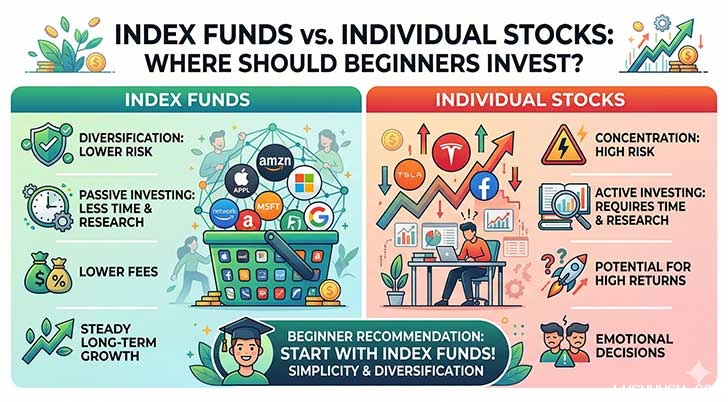
Index Funds vs. Individual Stocks: Where Should Beginner Investors Actually Put Their Money? (Part 2)
You've decided to invest. Good. That decision alone puts you ahead of the majority of people who intend to invest "someday" but never actually start.
Now comes the question that stops most beginners in their tracks: what do I actually buy?
Open any financial news site and you'll find people arguing passionately about which company is about to surge, which sector is going to dominate, and which stocks you absolutely must own right now. It's loud, it's confident, and most of it is noise.
Today we're cutting through that noise. This is a direct, honest comparison of the two main paths available to stock market investors individual stocks and index funds with real numbers, real historical examples, and a clear answer about which one is right for you as a beginner.
What Are Individual Stocks, Really?
When you buy a share of stock, you're purchasing a fractional ownership stake in one specific company. If you buy 10 shares of a company trading at $50 per share, you've invested $500 and you now own a tiny slice of that business.
What happens to your investment from there depends entirely on what happens to that company. If it grows revenues, expands into new markets, and increases profitability your share value rises. If it launches a product people love, announces a major contract, or beats earnings expectations the price typically goes up.
Some companies also pay dividends regular cash distributions to shareholders, usually quarterly. Mature, profitable companies like Johnson & Johnson, Coca-Cola, and Procter & Gamble have paid consistent dividends for decades. For income-focused investors, these are attractive.
The Upside of Individual Stock Picking
The appeal of individual stocks is easy to understand. The potential returns on a single great pick can be extraordinary:
- Apple (AAPL): $1,000 invested in January 2010 grew to over $40,000 by 2024
- Amazon (AMZN): $1,000 invested in 2010 grew to over $15,000 by 2024
- Netflix (NFLX): $1,000 invested in 2010 was worth over $35,000 a decade later
Stories like these are real. And they're compelling. Who wouldn't want to have spotted Amazon in 2010?
The Problem: The Losers Nobody Talks About
Here's what the success stories leave out: for every Apple or Amazon, there are hundreds of companies that declined significantly, went bankrupt, or simply flatlined for years while the broader market grew.
Consider these:
- Blockbuster Video: Once valued at nearly $5 billion. Filed for bankruptcy in 2010.
- Kodak: A 100-year-old company that dominated photography. Filed for bankruptcy in 2012.
- Enron: One of America's largest companies in 2000. Collapsed in fraud scandal by 2001, wiping out shareholders completely.
- Bed Bath & Beyond: Popular retail chain that filed for bankruptcy in 2023.
None of the people who invested in these companies thought they were making a mistake. Many of them were invested in companies they used and believed in household names with long histories.
The uncomfortable truth is this: picking individual stocks that will outperform the market is something that even professional fund managers, with teams of analysts and decades of experience, fail to do consistently. Research by S&P Dow Jones Indices shows that over a 20-year period, approximately 90% of actively managed large-cap funds underperform the S&P 500 index. Not some managers 90% of them.
If professionals with every advantage fail to consistently beat the index, what does that say about the odds for a part-time beginner investor?
What Are Index Funds? (And Why They Work)
An index fund is a type of investment fund designed to track the performance of a specific market index a predefined list of companies. The most commonly tracked index for beginners is the S&P 500, which consists of the 500 largest publicly traded companies in the United States.
When you invest in an S&P 500 index fund, you're not betting on any single company. You're buying a small stake in all 500 of them simultaneously companies like Apple, Microsoft, Amazon, Google, JPMorgan Chase, Johnson & Johnson, and 495 others.
The fund is passively managed, meaning it doesn't require a team of analysts making decisions about what to buy and sell. It simply holds the stocks in the index in proportion to their market value. When the index changes (companies are added or removed), the fund adjusts automatically.
The Historical Performance Case for Index Funds
The S&P 500 has returned an average of approximately 10% per year since its inception in 1957, before inflation or roughly 7% annually after inflation. No single decade has been perfectly smooth there were brutal downturns in 20002002, 20082009, and 2020 but across all of them, the long-term trajectory has been consistently upward.
To put that in concrete terms:
InvestmentAnnual ReturnValue After 30 Years ($10,000 initial)Standard savings account (0.5%)0.5%$11,614Bonds (average ~4%)4%$32,434S&P 500 Index Fund (~10%)10%$174,494Single stock (varies wildly)UnknownUnknown
That $10,000 in an S&P 500 index fund grows to over $174,000 over 30 years at historical average returns. That's not a guarantee past performance doesn't guarantee future results but it's the most data-backed baseline available for long-term equity investment.
The Cost Difference: Small Numbers, Enormous Impact
One of the most significant advantages of index funds that rarely gets discussed clearly is the fee structure.
Every investment fund charges an expense ratio an annual fee expressed as a percentage of your investment. This fee is deducted automatically and reduces your returns.
Here's how the numbers compare:
Fund TypeTypical Expense RatioAnnual Cost on $10,000Actively managed mutual fund0.75%1.5%$75$150Actively managed fund (high-end)1.5%2.5%$150$250S&P 500 Index Fund (Vanguard VOO)0.03%$3Total Market Index Fund (Vanguard VTI)0.03%$3
That difference might seem trivial $3 vs $150 per year on $10,000 seems like a rounding error.
But here's what compound math does to that fee difference over time:
- $100,000 invested at 10% annual return over 30 years = $1.74 million
- $100,000 invested at 8.5% annual return (after a 1.5% annual fee) over 30 years = $1.13 million
The fee difference costs you over $600,000 in total wealth over 30 years. That's not a small number. That's the difference between a comfortable retirement and a genuinely wealthy one and it comes purely from the cost of the fund, not the market performance.
Index funds win on fees in a way that actively managed funds simply cannot match because of how they're structured.
The Diversification Argument: Why Spreading Risk Matters
When you own individual stocks, your financial wellbeing is tied to the decisions of a specific management team, the competitive dynamics of a single industry, and countless unpredictable events regulatory changes, supply chain disruptions, scandals, or simply a product that didn't land as expected.
When you own an index fund, you own hundreds or thousands of companies across dozens of industries. A single company failing even a major one has a limited impact on your total portfolio.
Consider what happened in March 2020 when COVID-19 caused a sudden market crash. The S&P 500 dropped approximately 34% from peak to trough over about a month. That sounds devastating. But it recovered completely within five months and went on to hit new highs. Investors who held through it came out ahead. Investors who panicked and sold locked in losses permanently.
Now consider what happened to airlines specifically during the same period. Delta Air Lines dropped over 60%. United Airlines dropped over 70%. Investors concentrated in travel and hospitality stocks faced a much more severe decline that took years longer to recover from in some cases.
Diversification isn't just about protecting against permanent loss. It's about managing the emotional experience of volatility which is what causes most investors to make the worst possible decisions at the worst possible times.
The Time Cost: What Individual Stock Investing Actually Requires
People who advocate for stock picking often underestimate what it genuinely requires to do it responsibly.
Investing in an individual company with real conviction means:
- Reading the company's quarterly earnings reports (10-Q filings) dense financial documents released four times per year
- Reading the annual report (10-K) often 100+ pages
- Following industry news to understand competitive dynamics
- Monitoring management team changes, which can significantly affect direction
- Understanding the macroeconomic factors affecting the specific sector
- Tracking valuation metrics to know if the stock is fairly priced, overvalued, or cheap
If you're genuinely interested in this kind of deep research and find it engaging, individual stock investing can be rewarding both financially and intellectually. But it's not a casual activity. Doing it properly for a portfolio of 810 stocks could easily require 510 hours per week.
Index fund investing requires approximately zero ongoing time. Buy it. Set up recurring purchases. Don't look at it. Let it compound.
For the vast majority of people who have careers, families, interests, and limited hours that time cost is a decisive factor.
What the Experts Actually Say
This isn't a case where the experts are divided. The consensus among serious, evidence-based investors and academics is unusually clear.
Warren Buffett, arguably the greatest individual stock picker of the 20th century, has consistently said that for most investors, a low-cost S&P 500 index fund is the best investment available. In his 2013 letter to Berkshire Hathaway shareholders, he stated that his instructions for his estate's management after his death include putting 90% into an S&P 500 index fund.
Jack Bogle, founder of Vanguard and creator of the first index fund for retail investors, spent his entire career making the case for passive investing. His core argument: in a zero-sum game where every outperformer has a corresponding underperformer, the only guaranteed way to capture the market's return is to own the whole market at minimal cost.
Academic research including work by Nobel Prize-winning economist Eugene Fama supports the efficient market hypothesis: the idea that stock prices already reflect all available information, making consistent outperformance through stock picking essentially impossible over long time horizons.
The people arguing loudest for stock picking on social media and financial YouTube channels are, more often than not, either selling something or recounting recent wins while quietly ignoring losses.
Can You Do Both? The Core-and-Explore Approach
Here's an approach that many experienced investors use and one that makes sense for beginners who want some individual stock exposure without betting their financial future on it:
8090% Core: Low-cost, diversified index funds. This is your wealth-building engine. It runs on autopilot, compounds over decades, and doesn't require your attention.
1020% Explore: Individual stocks of companies you've genuinely researched, understand, and believe in for specific reasons. This portion satisfies the intellectual engagement of picking stocks while limiting the damage if you're wrong.
This approach captures the benefits of both strategies. Your core is protected and compounding. Your explore portion gives you the experience and engagement of following specific companies and if you're right, a nice bonus return on top of your index performance.
The critical rule: the "explore" portion should only contain money you could lose entirely without affecting your financial plan. Treat it as learning investment, not retirement savings.
A Practical Starting Point for Beginners
If you're ready to start and want the simplest, most proven entry point into the stock market, here's a concrete starting recommendation:
Open a brokerage account with Fidelity, Vanguard, or Charles Schwab all three are reputable, low-cost, and beginner-friendly with strong educational resources.
Make your first purchase: Choose one of these broad market index funds as your starting position:
- Vanguard S&P 500 ETF (VOO): Tracks the 500 largest US companies. Expense ratio: 0.03%
- Vanguard Total Stock Market ETF (VTI): Tracks the entire US stock market (over 3,600 companies). Expense ratio: 0.03%
- Fidelity Zero Total Market Index Fund (FZROX): No expense ratio at all literally free to own
Set up automatic monthly contributions. Even $50 or $100 per month. The consistency matters more than the amount.
Commit to not selling during downturns. Markets will drop 10%, 20%, even 30% at some point while you're invested. That's normal. Every major drop in market history has eventually recovered and gone on to new highs. Selling during a drop converts a temporary paper loss into a permanent real one.
The Bottom Line
If you remember nothing else from this article, remember this:
Individual stocks: High potential reward, high concentration risk, requires significant ongoing research, most professionals fail to outperform the benchmark consistently over time.
Index funds: Broad diversification, very low cost, historically strong long-term returns, zero ongoing time required, backed by the most respected names in investing.
For beginners building wealth for the long term retirement, financial freedom, generational wealth index funds are the clearest, most evidence-backed starting point available. Not because they're exciting. Because they work.
Start boring. Stay consistent. Let compounding do the heavy lifting.
In Part 3 of the Investments series, we'll cover the account structures that make investing even more powerful the tax-advantaged accounts like 401(k)s, IRAs, and Roth accounts that let your investments grow more efficiently. The right account type can add thousands to your long-term returns without changing a single investment.
Are you leaning toward index funds, individual stocks, or a combination of both? Share your thinking in the comments especially if you've already started investing and have learned something from the experience.







All comments, feedback, information or materials except email addresses submitted to Lush Wush shall be considered non-confidential and its property. By submitting such comments, feedback, information or materials to us, you agree to a no-charge assignment of all worldwide rights. For the best interest of the community, please refrain from posting vulgar comments, profanity, or personal attacks. Comments submitted may automatically be flagged for review by our moderation team before appearing on the website.