
Real Estate Vs. Stock Market: The Ultimate Investment Comparison
 174
174  0
0  20
20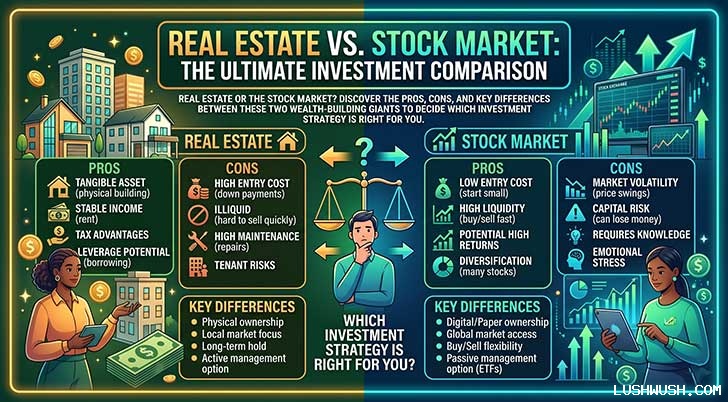

Real Estate vs. Stock Market: The Ultimate Comparison
Two $50,000 Decisions, Fifteen Years Apart
Fifteen years ago, two coworkers each came into $50,000 an inheritance for one, years of disciplined saving for the other. They sat on opposite sides of the same office and made completely different bets with it.
Priya put her $50,000 down on a $250,000 rental duplex, financing the rest with a mortgage. She spent the next decade and a half dealing with tenants, a broken water heater at an inconvenient hour, and one stretch of two months without a renter that ate into her savings.
Marcus put his $50,000 into a broad stock market index fund and, aside from occasionally checking the balance during scary headlines, did essentially nothing else. No tenants, no repairs, no 2 a.m. phone calls.
Fifteen years later, both of their $50,000 decisions had grown substantially just by very different amounts, through very different mechanisms, and with very different amounts of effort along the way. We'll walk through exactly what each path turned into later in this article, because the real numbers tell a more interesting story than either side of this debate usually admits on its own.
The Case for Real Estate: The Tangible Asset
Real estate means purchasing physical property residential homes, commercial space, or raw land to generate rental income, hold for appreciation, or both. It's the asset class you can literally stand inside.
The Pros:
- Tangible value you can see it, touch it, live in it, unlike a digital number on a brokerage app
- Passive cash flow a well-managed rental property can generate steady monthly income that helps cover, or exceed, its own costs
- Tax advantages real estate investors commonly benefit from meaningful deductions, including property depreciation and mortgage interest
The Cons:
- High barrier to entry a typical down payment alone can run $30,000-$80,000+ depending on the property and market, before closing costs
- Illiquidity you can't cash out of a house in an afternoon; selling typically takes weeks to months and involves agent commissions often running 5-6% of the sale price
- The "tenant" factor being a landlord is rarely fully passive, even with a property manager taking a cut of the rent to handle the day-to-day
Why Leverage Changes the Math
Real estate is one of the only common investments where a bank will hand you 80% of the purchase price to buy an asset you don't yet own outright. Put down $50,000 on a $250,000 property, and you now control a quarter-million-dollar asset meaning even modest appreciation on the property's full value compounds against a much smaller amount of your own money. This leverage effect is the single biggest reason real estate returns can outpace what the raw appreciation percentage alone would suggest.
The Real Costs of Being a Landlord
The "passive" cash flow language undersells what property ownership actually involves. Beyond the mortgage itself, expect property taxes and insurance (commonly running $250-$400/month combined on a mid-priced property), routine maintenance, occasional vacancy between tenants, and the very real possibility of a 2 a.m. call about a burst pipe. None of this is disqualifying plenty of investors do this successfully but it's not the fully hands-off experience the word "passive" implies.
The Case for the Stock Market: The Paper Asset
Investing in the stock market means buying fractional ownership in publicly traded companies, or in broad index funds and ETFs that hold hundreds of companies at once.
The Pros:
- Ultimate liquidity sell your shares with a few clicks and have cash in your account within a couple of business days
- Low barrier to entry fractional shares and SIPs mean you can start with $10 or $50 a month, not $50,000
- Truly passive no leaky roofs, no tenant calls, no 2 a.m. anything
- Historical returns the broader stock market has historically averaged roughly 8-10% annually over long periods, comfortably outpacing inflation over time
The Cons:
- High volatility a 20% drop in a single bad month isn't rare; it requires genuine emotional discipline to hold through
- No built-in leverage you're generally investing with 100% of your own cash, since margin trading carries real risk that isn't appropriate for most long-term investors
Why Liquidity and Low Barriers Matter
The $50,000 barrier to meaningfully entering real estate simply doesn't exist here. A 22-year-old with $50 a month and three decades ahead of them has full access to the exact same asset class, at the exact same terms, as someone starting with $500,000 a genuine structural advantage for anyone still building their initial capital.
The Volatility You Have to Stomach
Marcus's index fund didn't grow in a smooth, predictable line over his 15 years. It almost certainly included at least one stretch where his $50,000 was worth noticeably less on paper than the day he invested it, purely from short-term market swings that had nothing to do with the long-term trend. Riding through that dip without panic-selling is the actual skill being tested here not picking the right fund.
Real-World Example: The Same $50,000, Two Different Paths
Let's put real numbers behind Priya and Marcus's story.
Priya's real estate path:
- $50,000 down payment on a $250,000 property, $200,000 mortgage at 7% over 30 years
- Monthly mortgage payment (principal + interest): $1,331
- Adding estimated taxes and insurance: $1,631/month total housing cost
- Rental income: $1,900/month, leaving modest positive cash flow after expenses
- After 15 years, assuming 3.5% annual appreciation: property value $418,825
- Remaining mortgage balance at year 15: $148,010
- Equity built: $270,815
- Plus roughly 15 years of modest net cash flow: $21,000
- Total position: $292,000 from an initial $50,000 about 5.8x her original investment
Marcus's stock market path:
- $50,000 invested as a lump sum in a broad index fund, no further contributions
- Assumed average annual return: 9%
- After 15 years: $182,000
- Total position: $182,000 from an initial $50,000 about 3.6x his original investment
On paper, Priya's leveraged real estate bet outgrew Marcus's stock investment by a meaningful margin, even though her property's own appreciation rate (3.5%) was well below Marcus's assumed stock return (9%). That gap is almost entirely the leverage effect described earlier and it's exactly why real estate is so often held up as the superior wealth-builder. But that comparison only tells half the story, which is exactly what the next section is about.
What Leverage Really Means (And Why It Cuts Both Ways)
Leverage amplifies outcomes in both directions, not just the favorable one. If Priya's property had stayed flat or dropped 10% over those 15 years instead of appreciating 3.5% annually which does happen, particularly in concentrated local markets her equity position would have shrunk dramatically relative to her $50,000 investment, while Marcus's diversified index fund would have been far more insulated from any single local downturn. A $250,000 property that drops to $225,000 wipes out half of a $50,000 down payment's equity cushion; the exact same percentage drop across a diversified fund holding hundreds of companies is a much softer hit.
This isn't an argument against real estate Priya's numbers above are genuinely realistic for a reasonably run rental property. It's a reminder that leverage is a tool that makes both good and bad outcomes larger, and the comparison above assumed a fairly typical, non-disastrous 15 years for both paths.
Common Mistakes People Make When Choosing Between Real Estate and Stocks (What NOT to Do)
- Assuming leverage only amplifies gains, forgetting it equally amplifies losses in a down market or a bad property
- Underestimating true property costs maintenance, vacancy, closing costs, and agent commissions when comparing "returns" against a stock portfolio's much lower ongoing costs
- Panic-selling stocks during a downturn, converting a temporary paper loss into a permanent, realized one
- Concentrating everything into a single property instead of diversifying, versus a broad index fund that's inherently spread across hundreds of companies
- Ignoring your own liquidity needs, tying up emergency-level cash into an asset that can take months to convert back to cash
- Treating a primary residence's "return" as directly comparable to an investment property or stock portfolio, when you'd be paying for housing either way
- Forgetting to value your own time when doing DIY property management, effectively working an unpaid part-time job that doesn't show up in the raw return numbers
The Verdict: Which Is Actually Better for You?
There's no universal winner here the right choice depends heavily on your capital, temperament, and how hands-on you want to be.
Real estate tends to fit better if: you have significant upfront capital available, you're comfortable with physical assets and some hands-on management (or paying someone else to handle it), you specifically want to use bank leverage, and you're not likely to need that capital back quickly.
The stock market tends to fit better if: you want a genuinely passive, hands-off approach, you're starting with a smaller monthly amount rather than a lump sum, high liquidity matters to you, and you have the temperament to hold through volatility over a decade or more without panic-selling.
Many investors, over a long enough timeline, eventually do both starting with stocks while capital builds, then adding real estate once there's enough saved for a meaningful down payment without draining an emergency fund in the process.
Your Practical Action Plan to Decide Between Real Estate and Stocks
- Take an honest inventory of your available capital a large lump sum available now points differently than a smaller amount you can invest monthly
- Decide how hands-on you genuinely want to be, not how hands-on you imagine you'll be in theory
- Check your liquidity needs first money you might need within a few years generally shouldn't go into an illiquid property
- Model realistic numbers for your specific market, rather than relying on national averages that may not reflect your local rental yields or price trends
- Consider starting with stocks while capital builds, keeping the real estate door open once you have a genuine down payment plus a separate emergency fund intact
- Diversify either way a single rental property or a single stock both carry concentration risk that a broad index fund or a multi-property portfolio doesn't
- Revisit the decision periodically as your capital, risk tolerance, and life circumstances change, rather than treating it as a one-time, permanent choice
This is general financial education, not personalized investment advice real estate markets, mortgage terms, and investment returns vary significantly by location and timing, so it's worth discussing your specific situation with a financial advisor before committing significant capital either way.
Beginner FAQ: Real Estate vs. Stock Market
Can I do both real estate and stocks at the same time? Yes, and many long-term investors eventually do exactly this. A common approach is building stock market investments first, since the barrier to entry is so much lower, then adding real estate once there's enough capital for a genuine down payment without depleting savings or an emergency fund.
Is real estate really less risky than the stock market since it doesn't seem to "crash" as often? Real estate prices are simply reported and traded far less frequently than stocks, which makes the ups and downs feel smoother even when they're happening. Property values absolutely can and do decline in specific markets and periods it's just less visible day to day than a stock ticker, not inherently less risky in every case.
What about REITs is that a way to get real estate exposure without buying property? Real Estate Investment Trusts (REITs) let you invest in real estate through the stock market, buying shares in companies that own income-producing property. They offer real estate-like exposure with stock market-like liquidity, though you give up the direct leverage and hands-on control of owning physical property yourself.
How much upfront capital do I actually need to get started in each? Real estate typically requires a meaningful down payment plus closing costs commonly tens of thousands of dollars depending on the property and market. The stock market, by contrast, can genuinely be started with $10-$50 through fractional shares or a small monthly SIP, making it the far more accessible starting point for someone still building capital.
Priya and Marcus didn't make a wrong decision and a right one. They made two different, defensible bets, and both grew meaningfully over 15 years through mechanisms that reward completely different strengths Priya's tolerance for hands-on management and leverage, Marcus's patience and comfort with market volatility. The real question was never "which asset is objectively better." It's which trade-offs you're actually willing to live with for the next decade or more.
Curious what your own version of Marcus's path could look like? Use our free Visual Compound Interest & SIP Calculator to see exactly how a lump sum or monthly investment in the stock market could grow over your own timeline, with a visual breakdown of your contributions versus pure compounding.




















All comments, feedback, information or materials except email addresses submitted to Lush Wush shall be considered non-confidential and its property. By submitting such comments, feedback, information or materials to us, you agree to a no-charge assignment of all worldwide rights. For the best interest of the community, please refrain from posting vulgar comments, profanity, or personal attacks. Comments submitted may automatically be flagged for review by our moderation team before appearing on the website.