
Mutual Funds Explained: The Beginners Guide To Investing Without The Stress
 180
180  0
0  17
17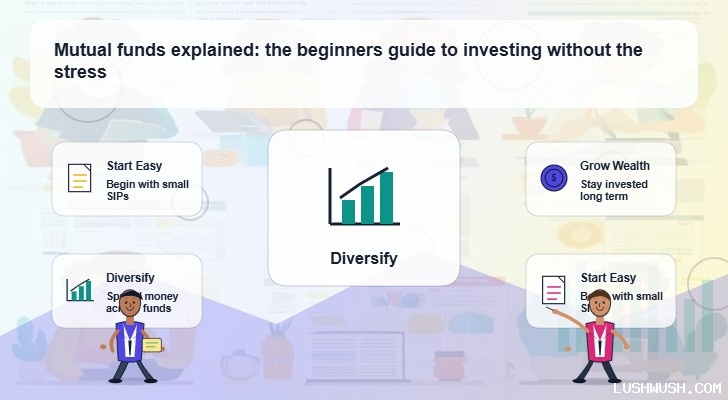

Mutual Funds Explained: The Beginner's Guide to Investing Without the Stress
The App With a Thousand Options and Zero Instructions
Ravi finally downloaded a brokerage app, genuinely ready to start investing. He opened it, stared at a search bar, typed nothing, and closed the app. Thousands of companies stared back at him with no obvious starting point which ones were financially healthy, which were about to crash, which he'd regret picking in six months. He didn't open the app again for half a year.
That six-month freeze wasn't free. Running the numbers on what he eventually did start a modest $200 a month at a typical 8% average annual return that single half-year of hesitation cost him roughly $12,860 off his eventual 30-year total, purely from starting six months later than he could have. Not from picking a bad investment. From picking nothing at all.
When Ravi finally did start, it wasn't by picking individual stocks. It was through a mutual fund, and the difference in stress was immediate. This is exactly the problem mutual funds are built to solve.
So What Actually Is a Mutual Fund?
Picture 1,000 different people each putting $1,000 into a shared pot now there's $1,000,000 sitting there. A professional fund manager takes that pool and invests it across dozens or hundreds of companies, bonds, or other assets. Everyone in the pool owns a small slice of everything the fund holds.
That's a mutual fund. You don't pick individual stocks, you don't watch the market daily, and your investment grows or shrinks based on how the overall fund performs which is a fundamentally calmer experience than staring at a search bar full of thousands of unfamiliar tickers the way Ravi did.
Why Do People Actually Choose Mutual Funds?
Instant Diversification (Without the Homework)
Buy one individual stock, and your money rides entirely on that one company's fate. Buy into a mutual fund, and your money spreads across many companies at once if one struggles, the others can offset it. This is risk reduction that happens automatically, without requiring you to personally research every underlying company.
Professional Management, Liquidity, and Low Entry Cost
Fund managers spend entire careers studying markets and reading financial reports professionally you're effectively hiring that expertise rather than building it yourself from scratch. Unlike real estate or fixed deposits, mutual funds stay liquid; you're not locked out of your own money for years at a time. And the entry cost is genuinely low: many funds accept SIP (Systematic Investment Plan) contributions of just a few hundred rupees or dollars a month, rather than requiring a large lump sum to begin.
The Different Types of Mutual Funds
Not every mutual fund plays the same role, and matching the type to your actual timeline matters more than most beginners realize.
Equity, Fixed Income, and Balanced Funds
Equity Funds invest primarily in stocks, offering the highest long-term growth potential alongside the most short-term ups and downs the natural choice for someone investing for 10+ years. Fixed Income (Debt) Funds invest in bonds and government securities, trading higher growth for more stability and predictability, suited to investors prioritizing steadier, more modest returns. Balanced (Hybrid) Funds split between stocks and bonds, offering a middle ground: some growth potential from the equity side, some stability from the debt side, without needing to manage two separate funds yourself.
Sector Funds The Higher-Risk Specialist
Sector Funds concentrate in one specific industry technology, healthcare, energy which can deliver strong returns if that sector booms, but carries real concentration risk since there's no diversification cushioning a downturn in that specific industry. These fit investors with a genuinely strong, researched view on a particular sector, not as a default starting point for a beginner.
How to Actually Start Investing (The Four-Point Checklist)
Getting started is genuinely straightforward most platforms let you get set up in under 30 minutes, through a mutual fund company directly, a financial advisor, or an online brokerage. Before committing to any specific fund, check four things:
- Investment objective does the fund's stated goal (growth, income, capital preservation) actually match what you're trying to accomplish?
- Risk level funds are typically labeled low, moderate, or high risk; pick what matches how you'd genuinely feel watching your portfolio drop 20% in a bad month, not how you imagine you'd feel
- Fees this one matters more than almost anything else, and deserves its own section
- Track record past performance doesn't guarantee future results, but 5-10 years of history shows consistency and how the fund handled real downturns, not just good years
The Fee Conversation Nobody Wants to Have (But Should)
Mutual fund fees can quietly eat into your returns far more than most new investors expect. These fees are usually expressed as an Expense Ratio a small annual percentage of your investment, often 0.5% to 2.0%. It looks trivial on paper. Over decades, it genuinely isn't.
Real-World Example: What $50,000 Actually Becomes at Two Different Fee Levels
Let's run the actual math on a $50,000 investment held for 25 years, assuming an 8% gross annual return before fees are subtracted:
- At a 0.5% expense ratio (net return 7.5%): $50,000 grows to roughly $304,900
- At a 2.0% expense ratio (net return 6.0%): $50,000 grows to roughly $214,600
The gap: roughly $90,300 not from a different investment strategy, not from better stock picking, purely from a 1.5 percentage point difference in annual fees, compounding quietly for 25 years. That single number is exactly why checking the expense ratio before committing to a fund deserves real attention rather than a quick skim. Index funds, which passively track a market index rather than relying on active stock-picking, are known for particularly low expense ratios and are worth comparing directly against actively managed alternatives.
Time Is Your Best Friend Here: The $100 vs. $500 Experiment
The real power of mutual funds barely shows up in year one it shows up in year 15, year 20, year 30, through compounding: your returns generating their own returns, accelerating the longer money stays invested. Here's exactly what that means in dollars, comparing two savers at the same 8% average return:
- Saver A: invests $100/month for 30 years total contributed: $36,000 ending value: $149,000
- Saver B: invests $500/month for 10 years total contributed: $60,000 ending value: $91,500
Saver A contributed $24,000 less out of pocket than Saver B, and still ended up with roughly $57,500 more. This is exactly why starting early matters more than starting big time in the market, not the size of any individual contribution, is doing the heaviest lifting.
Why SIPs Smooth Out Market Volatility (Not Just Build Discipline)
Beyond the habit-forming benefit, investing through a SIP rather than a single lump sum has a real mathematical advantage during choppy markets, commonly called dollar-cost averaging. Here's what that looks like over a volatile six-month stretch, investing $300/month into a fund whose share price bounces around:
- Month 1 at $30/share buys 10 shares
- Month 2 at $22/share buys 13.64 shares
- Month 3 at $18/share buys 16.67 shares
- Month 4 at $24/share buys 12.5 shares
- Month 5 at $28/share buys 10.71 shares
- Month 6 at $26/share buys 11.54 shares
Total invested: $1,800, total shares owned: 75.06, average cost per share: $23.98 noticeably below the $30 starting price, because the SIP automatically bought more shares when prices dipped.
Compare that to investing the full $1,800 as a lump sum in month 1 at $30/share: only 60 shares total. By month 6, at $26/share, the SIP investor's position is worth $1,952 (a gain), while the lump-sum investor's position is worth $1,560 (a loss) purely from the timing of when the money went in, not from picking a different fund. This is exactly why spreading contributions out over time removes some of the pressure to "time" any single entry point correctly.
Common Mistakes Beginner Mutual Fund Investors Make (What NOT to Do)
- Freezing and doing nothing out of choice overload, exactly as Ravi did inaction has a real, calculable cost, not just an opportunity cost in the abstract
- Chasing last year's top-performing fund without checking whether that performance has actually been consistent over 5-10 years
- Ignoring the expense ratio entirely, missing a difference that can compound into tens of thousands of dollars over a long enough horizon
- Concentrating in one hot sector fund based on a trending story, without genuine conviction or research behind it
- Mismatching fund risk level to timeline putting money you'll need in two years into an aggressive equity fund built for a decade-plus horizon
- Panic-selling during a downturn, converting a temporary paper loss into a permanent, realized one
- Relying on remembering to invest manually each month instead of automating contributions, which is where consistency quietly falls apart for most beginners
Your Practical Action Plan to Start This Week
- Define your investment objective and timeline first growth, income, or capital preservation, and over what number of years
- Choose a risk level that matches your actual temperament, not an idealized version of how calm you'd stay during a 20% drop
- Compare expense ratios across at least 2-3 similar funds before committing to any single one
- Check the 5-10 year track record, specifically noting how the fund performed during a downturn, not just its best years
- Set up an automatic SIP contribution on payday, removing the need to remember or feel motivated each month
- Start now, even with a small amount, rather than waiting for a "better time" that Ravi's six-month freeze shows can quietly cost thousands
- Revisit your fund choice annually, but resist the urge to check performance daily, which tends to create anxiety without adding any useful information
Beginner FAQ: Mutual Funds for Beginners
What's the difference between a mutual fund and an index fund? An index fund is technically a type of mutual fund (or ETF) that passively tracks a specific market index rather than relying on a manager actively picking investments. This passive approach is exactly why index funds tend to carry much lower expense ratios than actively managed mutual funds, often a fraction of a percent.
How much money do I actually need to start a SIP? Very little many mutual funds accept SIP contributions starting at just a few hundred rupees or dollars a month, making this one of the most accessible entry points into investing, regardless of how much lump-sum capital you have available upfront.
Can I lose all my money in a mutual fund? Losing everything is extremely unlikely given the built-in diversification across many holdings, but mutual funds can absolutely lose value, sometimes significantly, particularly equity and sector funds during a market downturn. Diversification reduces risk; it doesn't eliminate it entirely.
How do I know if a fund's expense ratio is "too high"? Compare it against similar funds with the same investment objective and risk level a 1.5% expense ratio might be reasonable for a specialized actively managed fund but excessive for a broad index fund that could achieve similar exposure at a fraction of the cost. When two funds serve a similar purpose, the lower expense ratio deserves a real advantage in your decision, not just a passing glance.
Are mutual fund gains taxed differently than regular income? Tax treatment varies significantly by country and by how long you've held the investment, with many places offering more favorable rates for gains held longer term versus short term. This is genuinely worth checking against your specific local tax rules, or with an accountant, since it can meaningfully affect the actual after-tax return you keep.
Ravi's six-month freeze wasn't really about fear of the stock market it was about facing thousands of choices with no framework for narrowing them down. Mutual funds remove that specific problem entirely: one decision about type and risk level, one automated monthly contribution, and decades of compounding doing the rest of the work quietly in the background. Mutual funds aren't a shortcut to getting rich quickly, but they're one of the most accessible, professionally managed ways to build real wealth without needing to become a financial expert yourself.
Want to see exactly what your own monthly contribution could grow into over 10, 20, or 30 years? Use our free Visual Compound Interest & SIP Calculator to run the numbers on your own timeline and expected return.




















All comments, feedback, information or materials except email addresses submitted to Lush Wush shall be considered non-confidential and its property. By submitting such comments, feedback, information or materials to us, you agree to a no-charge assignment of all worldwide rights. For the best interest of the community, please refrain from posting vulgar comments, profanity, or personal attacks. Comments submitted may automatically be flagged for review by our moderation team before appearing on the website.