
Investing 101: How To Make Your Money Work For You (part 1)
 157
157  0
0  15
15

Investing 101: How to Make Your Money Work for You A Beginner's Complete Guide (Part 1)
Let's start with a question most people don't think to ask: what is your money doing right now?
If it's sitting in a standard checking or savings account at a traditional bank, the honest answer is: slowly shrinking. Not in raw numbers your balance stays the same but in purchasing power. Inflation, currently running at 24% annually in most developed economies, means that $1,000 sitting in a zero-interest account today will buy you the equivalent of about $960 worth of goods next year. And $900 worth the year after that.
You're not building wealth by saving. You're losing ground slowly, quietly, and automatically.
Investing is how you stop losing ground and start gaining it. And despite what financial media and Wall Street jargon would have you believe, the fundamentals of investing aren't complicated. They're actually quite simple which is exactly why the financial industry doesn't rush to explain them clearly.
This is Part 1 of our Investments series. If you've followed the Smart Savings series, you already have your budget structured with the 50/30/20 rule and your emergency fund in place. Now it's time for the next move: putting your money to work.
What Investing Actually Means (In Plain English)
Strip away all the jargon and investing has one simple definition: putting money into something that has a reasonable expectation of growing in value or generating income over time.
That's it. No complex formulas required to understand the core concept.
When you work a job, you trade your time for money. There's a hard ceiling on that you only have 24 hours in a day, and you can only work so many of them. When you invest, you're creating a second source of value creation that doesn't require your time. Your money goes to work independently, generating returns whether you're at your desk, asleep, or on vacation.
Think of it this way: a job makes you money linearly more hours equals more income, and when you stop working, the income stops too. Investments make money compoundingly your returns generate their own returns, which generate their own returns, in an expanding cycle that doesn't require your ongoing effort.
That distinction linear income versus compounding growth is the fundamental reason why people who invest build wealth over time while people who only work and save don't.
Why Keeping Cash Is Not a Safe Strategy
Many people think of keeping money in a savings account as the "safe" choice compared to investing. This is understandable but it's based on a misunderstanding of what safety actually means in finance.
Here's the reality: safety isn't just about preventing your number from going down. It's also about maintaining purchasing power.
If you put $10,000 in a mattress today and retrieved it in 20 years, you'd have exactly $10,000. Feels safe. But if inflation averaged 3% annually over those 20 years, your $10,000 would only buy what $5,537 buys today. You'd have lost nearly half your purchasing power while the number on your account stayed perfectly still.
A standard checking account earning 0.01% interest barely moves the needle. A high-yield savings account earning 45% can keep up with or slightly beat moderate inflation which is why it's the right place for your emergency fund. But for long-term wealth building, you need returns that meaningfully exceed inflation over time. That requires investing.
The stock market, historically, has delivered average annual returns of approximately 710% per year after adjusting for inflation (the S&P 500's long-term average is roughly 10% before inflation, approximately 7% after). Gold has averaged around 78% annually over long periods. Neither of these is guaranteed but both have a strong historical track record of outpacing inflation significantly over decade-long periods.
Saving keeps you stable. Investing builds wealth.
The Myth That Stops Most People Before They Start
The most common reason people delay investing isn't lack of interest. It's a belief that they don't have enough money to start.
"I'll start investing when I have $5,000 saved." Then it becomes $10,000. Then it becomes "after I pay off this debt." Then it becomes "when things settle down." And the years pass.
This is the most expensive mistake in personal finance not because of what you lose, but because of what you never gain.
Let's look at two people to illustrate this concretely:
Person A starts investing $200 per month at age 25, earns an average of 8% annually, and stops contributing at age 35 just 10 years of contributions totaling $24,000.
Person B waits until age 35 to start, then invests $200 per month for 30 years until age 65, making contributions totaling $72,000.
At age 65, despite contributing three times as much money, Person B ends up with less than Person A because Person A had 30 extra years of compounding.
The earlier you start, the less you actually need to contribute to reach the same outcome. Starting with $50 or $100 per month at 25 is genuinely more powerful than starting with $500 per month at 40.
The Force That Powers All of This: Compound Interest
Albert Einstein allegedly called compound interest the eighth wonder of the world. Whether or not he actually said it, the sentiment is accurate.
Here's how compounding works in practice.
You invest $1,000. It earns 8% in year one: you now have $1,080.
In year two, you don't just earn 8% on your original $1,000. You earn 8% on $1,080. That gives you $1,166.40.
In year three, 8% on $1,166.40 gives you $1,259.71.
The numbers look modest in the early years. But watch what happens over time:
Year Balance (8% annual return, no additional contributions)1$1,0805$1,46910$2,15920$4,66130$10, 06340 $21,724
Your initial $1,000 becomes $21,724 in 40 years without you adding a single additional dollar. And if you're adding $200 per month throughout that period, the numbers become genuinely life-changing.
This is why time in the market matters so much more than timing the market. Every year you delay is compounding you're not benefiting from and that lost compounding is permanent.
Your Investment Options: The Beginner's Menu
Once you're ready to start, you have several vehicles to choose from. Here's an honest overview of the main options and what each is best suited for.
Stocks: Owning a Piece of a Business
When you buy a share of stock, you're purchasing a fractional ownership stake in a real company. If the company grows and becomes more valuable, your shares become worth more. Some companies also pay dividends regular cash distributions to shareholders from company profits, typically paid quarterly.
The appeal: Individual stocks have the potential for outsized returns. If you had bought Apple stock in 2010, you'd have gained over 4,000% by 2024.
The risk: Individual companies can also fail entirely, leaving shareholders with nothing. For every Apple or Amazon, there are hundreds of companies that declined or went bankrupt. Picking individual winners consistently is something that even professional fund managers fail to do reliably.
Best for: Investors who have done substantial research on a specific company, understand its business model and financials, and are comfortable with concentrated risk. Not the recommended starting point for beginners.
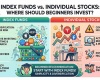
Index Funds and ETFs: The Smarter Starting Point
An index fund is a type of investment fund that tracks a specific market index most commonly the S&P 500, which is a collection of the 500 largest publicly traded companies in the United States. When you buy into an S&P 500 index fund, you're buying tiny fractional stakes in all 500 of those companies simultaneously.
The appeal: Instant diversification across 500 companies. If one company fails, it barely affects your overall portfolio. Historically, the S&P 500 has returned approximately 10% annually before inflation over long periods better than the vast majority of actively managed funds.
The cost advantage: Index funds are passively managed, meaning no team of expensive analysts is picking stocks. As a result, their fees (called expense ratios) are extremely low often 0.03%0.20% annually, compared to 1%2% for actively managed funds. That fee difference compounds significantly over decades.
ETFs (Exchange-Traded Funds) work similarly to index funds but trade on stock exchanges throughout the day like individual stocks. Popular examples include SPY and VOO (both tracking the S&P 500), and QQQ (tracking the Nasdaq 100 technology index). Minimum investment can be as low as the price of a single share sometimes under $50.
Best for: Almost every beginner investor. Low cost, automatic diversification, historically strong returns, and minimal time required to manage.
Mutual Funds: Professionally Managed Portfolios
Mutual funds pool money from many investors and a professional fund manager actively selects the investments. Unlike index funds, which passively track an index, mutual funds are actively managed the fund manager is making ongoing decisions about what to buy and sell.
The appeal: You get professional management without needing to make individual investment decisions.
The challenge: Research consistently shows that the majority of actively managed mutual funds underperform their benchmark index over 10-year and 20-year periods, after accounting for their higher fees. The managers being paid to beat the market usually don't and you pay more for the privilege of that underperformance.
Best for: Investors who want professional management and are in a fund with a strong long-term track record, low fees relative to its category, and a clear investment mandate that matches their goals.
Bonds: The Stability Option
When you buy a bond, you're essentially lending money to a government or corporation. In exchange, they pay you regular interest (called a coupon) and return your original investment at the end of the bond's term.
Bonds are less volatile than stocks and provide predictable income making them useful for balancing a portfolio. The trade-off is lower long-term returns compared to equities.
Best for: Investors approaching or in retirement who want to reduce portfolio volatility and preserve capital, or as a balancing element in a mixed portfolio.
Precious Metals: The Inflation Hedge
Gold and other precious metals serve a specific role in a well-rounded portfolio: they tend to hold value or rise when other assets decline, particularly during inflationary periods or economic crises. As covered in our Gold Mastery series, you can access gold through physical coins or bars, digital gold platforms, Gold ETFs, or sovereign gold bonds.
Best for: A small portfolio allocation (typically 515%) as a hedge against inflation and economic uncertainty. Not a replacement for equities in a long-term growth portfolio.
The Risk vs. Return Relationship: Understanding the Trade-Off
Every investment exists on a spectrum between risk and potential return. Understanding this relationship is fundamental to making good investment decisions.
Low risk, low return: Bank savings accounts, government bonds, money market funds. Your money is safe, but growth is minimal.
Medium risk, medium return: Balanced mutual funds, diversified bond portfolios, real estate investment trusts (REITs). More growth potential with moderate volatility.
Higher risk, higher potential return: Individual stocks, sector-specific ETFs, cryptocurrency, startup investment. Potentially significant gains, but also potential for significant losses.
The key insight: risk is not something to avoid entirely it's something to manage appropriately for your time horizon and goals.
If you're 25 years old investing for retirement 40 years away, short-term market drops are essentially irrelevant. You have decades of compounding ahead and time to recover from any downturn. Taking on equity risk makes sense.
If you're 60 years old with retirement three years away, a major market correction could significantly impact your retirement plans. Reducing risk and focusing on capital preservation makes sense.
Your investment strategy should match your time horizon, risk tolerance, and specific financial goals not anyone else's.
Where to Actually Start: Practical First Steps
Understanding the concepts is one thing. Here's how to translate that into action.
Step 1: Open an investment account. For most beginners, a brokerage account at a reputable platform is the starting point. Fidelity, Vanguard, and Schwab are widely respected for their low fees, strong educational resources, and customer service. Many offer fractional shares, meaning you can invest as little as $1 in any stock or ETF.
Step 2: Start with an index fund. Before exploring individual stocks or more complex investments, put your first investments into a broad market index fund. The Vanguard Total Stock Market ETF (VTI) or Vanguard S&P 500 ETF (VOO) are two of the most widely recommended starting points low cost, highly diversified, historically strong performance.
Step 3: Set up automatic recurring investments. Decide on a monthly amount even $50 or $100 and set up automatic transfers on payday. This implements dollar cost averaging automatically: you buy more shares when prices are low and fewer when prices are high, naturally averaging down your purchase cost over time.
Step 4: Commit to not touching it. Set up the investment and let it run. Don't check it daily. Don't panic when the market drops 10% in a bad month. The single most powerful thing most investors can do to improve their returns is simply not react to short-term volatility.
The Right Mindset: Think in Decades, Not Days
Financial news is designed to create urgency. Market up today, market down tomorrow, crisis in one country, rate decision from another central bank. All of it creates the impression that you should be doing something with your investments constantly.
The data says otherwise.
Studies consistently show that investors who trade more frequently achieve lower returns than investors who buy and hold. Every trade has a cost fees, taxes on gains, and the probability of buying or selling at the wrong time. Inactivity, when you're holding quality diversified assets, is genuinely a competitive advantage.
Warren Buffett, arguably the most successful investor of the 20th century, has said that his favorite holding period is "forever." His approach isn't complicated buy businesses with strong fundamentals and let them compound for decades.
You don't need to be Warren Buffett. You just need to buy broadly diversified, low-cost index funds, invest consistently, and stay out of your own way.
Coming Up in Part 2
Now that you understand what investing is, why it matters, and the main vehicles available to you, Part 2 of this series goes deeper into the specific accounts and tax structures that make investing even more powerful 401(k)s, IRAs, Roth accounts, and how using the right account type can dramatically increase your long-term returns.
The right investment in the wrong account structure can cost you thousands in unnecessary taxes. The next article makes sure that doesn't happen to you.
Have you made your first investment, or are you still figuring out where to start? Drop your current situation in the comments including what's holding you back if you haven't started yet. The conversation there is often as useful as the article itself.











All comments, feedback, information or materials except email addresses submitted to Lush Wush shall be considered non-confidential and its property. By submitting such comments, feedback, information or materials to us, you agree to a no-charge assignment of all worldwide rights. For the best interest of the community, please refrain from posting vulgar comments, profanity, or personal attacks. Comments submitted may automatically be flagged for review by our moderation team before appearing on the website.