
The 50/30/20 Budget Rule: How To Save Money Without Feeling Broke (part 1)
 203
203  0
0  24
24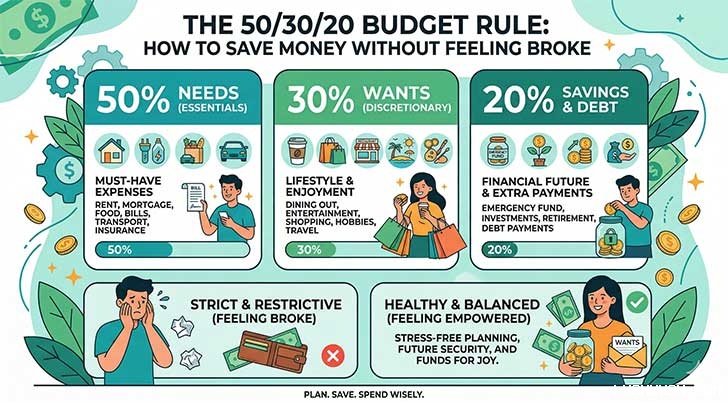

The 50/30/20 Budget Rule Explained: How to Save Money Without Feeling Deprived
Here's a scenario most people know too well.
Payday arrives. You feel that brief, satisfying rush of seeing your account balance. You pay some bills, maybe treat yourself a little, and life feels manageable. Then, somehow, by week three you're watching your balance nervously, rationing your spending, and wondering where it all went.
Two weeks later, payday comes again and the cycle repeats.
This isn't a discipline problem. It's not a character flaw. It's a systems problem. Most people have no clear structure for where their money should go, so it just goes driven by whatever feels urgent or appealing in the moment.
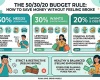
The 50/30/20 rule fixes this, and it does it without turning your financial life into a punishment system. That's why it's one of the most recommended budgeting frameworks in personal finance not because it's the most complex, but because it's simple enough that people actually stick to it.
This is Part 1 of our Smart Savings series. Let's break down exactly how it works, with real numbers and a clear path to implementing it starting with your next paycheck.
Where the 50/30/20 Rule Comes From
The 50/30/20 rule was popularized by Senator Elizabeth Warren and her daughter Amelia Warren Tyagi in their 2005 book All Your Worth: The Ultimate Lifetime Money Plan. Warren, a Harvard bankruptcy law professor at the time, developed the framework after years of studying why American families end up in financial crisis.
Her core finding was this: most people don't go broke because they spend too much on luxuries. They go broke because their fixed necessary expenses housing, transportation, utilities take up too large a share of their income, leaving no buffer for anything unexpected.
The 50/30/20 rule was designed as a structural solution: a way to ensure that no matter what you earn, your money is divided in proportions that keep you functional today, enjoying life now, and building security for tomorrow.
It has since become one of the most widely recommended frameworks by financial advisors, personal finance educators, and budgeting apps worldwide because the underlying logic holds at nearly every income level.
How the Rule Works: The Three Buckets
The foundation of the 50/30/20 rule is simple: take your monthly after-tax income and divide it into three categories using these percentages. Not gross income the amount that actually lands in your account after taxes and any mandatory deductions.
Let's use a concrete example throughout: a monthly after-tax income of $4,000.
The 50%: Needs What You Can't Live Without
$4,000 50% = $2,000 for Needs
This first bucket covers everything you genuinely must pay for the non-negotiable expenses that keep your life functioning. No needs go unpaid; no wants sneak into this category.
What Counts as a Need
Housing: Rent or mortgage payment. For most people, this is the largest single line item in their budget. Most financial advisors recommend keeping housing at or below 30% of gross income if your rent alone is eating 4045% of your after-tax income, that's the first structural problem to solve.
Basic groceries: Food at home not restaurants or takeout (those go in Wants), but the actual groceries needed to feed yourself and your household.
Utilities: Electricity, water, gas, and a basic internet connection. Note that a premium unlimited data plan or a bundled cable package might cross the line from need to want.
Transportation: Getting to work. This includes car payments, basic insurance, fuel, or public transit costs. A car lease on a luxury vehicle when a modest used car would serve the same purpose starts to blur the need/want line.
Minimum debt payments: The minimum required payment on any loans or credit cards. Anything above the minimum is optional and goes in savings/debt payoff.
Essential healthcare: Health insurance premiums, required prescriptions, and necessary medical costs.
What Doesn't Count as a Need (Even If It Feels Like One)
This is where most people's budgets quietly go wrong. The following are wants, not needs, even if they've become habits:
- Streaming services (Netflix, Spotify, etc.)
- Gym memberships
- The latest smartphone when your current one works fine
- Dining out, coffee shops, takeout
- Clothing beyond basics
When Your Needs Exceed 50%
If your needs category is consuming 60%, 65%, or more of your income, you have a structural income-to-expense problem that no amount of disciplined "latte cutting" will solve.
Possible solutions:
- Look for ways to reduce your largest fixed cost, which is usually housing (a roommate, a less expensive apartment, moving to a lower cost-of-living area)
- Renegotiate recurring bills internet providers, insurance premiums, and subscription costs are often negotiable or replaceable with cheaper alternatives
- Consider whether increasing income (a raise, a side project, additional hours) is a more realistic path than cutting further
The 50% target is a goal, not a judgment. Many people in high cost-of-living cities realistically operate at 5560% needs, and that's okay but it does mean adjusting the other two categories accordingly.
The 30%: Wants Spending That Makes Life Worth Living
$4,000 30% = $1,200 for Wants
This is the category that makes the 50/30/20 rule genuinely different from most budgeting systems and the reason people actually stick to it.
You have $1,200 this month that is yours to enjoy, completely guilt-free. No justification required. No tracking every dollar. Within this bucket, you spend freely on the things that bring you pleasure, connection, and enjoyment.
What Goes in the Wants Bucket
Dining and entertainment: Restaurants, bars, coffee shops, takeout, movie tickets, concerts, sporting events.
Shopping: Clothes beyond basics, home dcor, gadgets, books, hobbies.
Subscriptions and memberships: Netflix, Spotify, gym memberships, gaming subscriptions, magazine subscriptions.
Travel and experiences: Vacations, weekend trips, activities.
Personal care beyond essentials: Haircuts, spa days, premium grooming products.
Upgrades on necessities: The difference between a basic reliable car and the nicer model you want. The difference between the cheapest grocery option and buying the brands you actually prefer.
Why This Category Is the Key to Sustainable Budgeting
Every strict budgeting system that eliminates all discretionary spending shares the same fatal flaw: deprivation eventually produces rebellion. You tell yourself you won't spend on anything fun for six months, you hold out for four weeks, then you have a stressful week and spend $400 in a single impulsive day.
The 30% wants allocation solves this. It gives you a defined, guilt-free space for enjoyment. You're not failing your budget when you go to a nice dinner you're using your allocated wants budget exactly as designed.
The psychological effect is significant. When you know exactly how much fun money you have, you also naturally become more intentional about how you use it. Do you want to spend $200 on a night out this weekend knowing you have a concert next week? That's now a real, conscious choice rather than an accidental overspend.
Tracking Your Wants Spending
The easiest method: a separate spending account or a dedicated debit card. Transfer your monthly wants budget to it on payday. When it's gone, it's gone and you make intentional choices about what you spend it on along the way.
Many budgeting apps (YNAB, Monarch Money, EveryDollar) allow you to set a monthly limit for a "wants" category and alert you as you approach it.
The 20%: Savings and Financial Growth Building Your Future
$4,000 20% = $800 for Savings
This is the bucket that changes your financial trajectory. It's not the most exciting one, but it's the one you'll thank yourself for ten years from now.
$800 per month invested or saved consistently at 20% of a $4,000 income equals $9,600 per year. With reasonable investment returns, that compounds into something meaningful over a decade.
How to Divide Your 20%
The 20% savings bucket isn't one thing it should be divided intentionally based on your current financial situation. Here's a prioritized approach:
Priority 1: Emergency Fund (until you reach 36 months of expenses)
Before any investing, the first financial priority is an emergency fund liquid cash sitting in a savings account, accessible within days.
Why? Because without an emergency fund, any unexpected expense (car repair, medical bill, job loss) forces you to either go into debt or wipe out your investments at exactly the wrong moment. An emergency fund is the foundation everything else is built on.
Target: 3 months of total monthly expenses as a minimum; 6 months if your income is variable or your job is less stable.
For our $4,000/month example, 3 months of expenses might be $6,000. Putting $400/month into emergency savings gets you there in 15 months.
Priority 2: High-Interest Debt Payoff
If you're carrying credit card debt at 2436% annual interest, paying that off delivers a guaranteed "return" equal to the interest rate which no investment reliably beats. Once your minimum payments are covered in Needs, put extra savings toward eliminating high-interest debt before investing.
Priority 3: Retirement and Long-Term Investment
Once your emergency fund is solid and high-interest debt is cleared, the remaining savings go toward building long-term wealth:
- Employer-sponsored retirement accounts (401k, pension): Especially if your employer matches contributions that's a 50100% immediate return on your money that no other investment can match.
- IRA (Individual Retirement Account): Tax-advantaged investing for retirement.
- Index funds and ETFs: Low-cost, diversified long-term investment.
- Gold, mutual funds, or other assets: Depending on your diversification goals.
The Single Most Powerful Financial Habit: Automation
Here is the one behavioral change that makes the 20% savings rule actually work for the vast majority of people:
Automate the transfer on payday.
Set up your bank account to automatically move your savings amount whether that's $400, $800, or whatever your 20% calculates to into a separate savings or investment account the same day your paycheck arrives.
The psychological principle here is called "pay yourself first." You never see the money in your main spending account, so you never miss it. You budget and spend from what remains. This one habit eliminates the most common savings failure mode: intending to save whatever is left at the end of the month and discovering, month after month, that nothing is left.
Real-World Application: What 50/30/20 Looks Like at Different Income Levels
The beauty of a percentage-based system is that it scales. Here's how it looks across different incomes:
Monthly After-Tax Income50% Needs30% Wants20% Savings$2,500$1,250$750$500$4,000$2,000$1,200$800$6,000$3,000$1,800$1,200$8,000$4,000$2,400$1,600
The proportions stay the same; only the absolute dollar amounts change. Someone earning $2,500/month and someone earning $8,000/month can both follow the same framework.
Adjusting the Rule to Your Reality
The 50/30/20 rule is a framework, not a rigid law. Life doesn't always fit neatly into three equal categories, and that's okay.
If you live in a high cost-of-living city: A 60/20/20 or even 65/20/15 split may be more realistic. The priority is keeping savings at a meaningful percentage rather than forcing your housing costs down below 50% at any cost.
If you're aggressively paying off debt: Temporarily shift to 50/20/30 flipping the wants and savings allocations until high-interest debt is eliminated. Then move back to the standard framework.
If you're saving for a specific near-term goal: Temporarily boost the savings bucket to 2530% by trimming the wants budget for a defined period.
If you're just starting out and your income is low: Even a 50/35/15 split is dramatically better than no framework at all. Start where you can and adjust as your income grows.
Your First Action Step This Week
Reading about the 50/30/20 rule is the beginning. Applying it to your actual numbers is what changes your financial situation.
Here's what to do in the next 48 hours:
Step 1: Find your actual monthly after-tax income. Check your last paycheck or bank statement.
Step 2: Calculate your three targets 50%, 30%, and 20% of that number.
Step 3: Pull up your last month's bank statement and categorize every transaction as a Need, Want, or Savings item.
Step 4: Compare your actual spending in each category to the targets. Where are you over? Where are you under?
Step 5: Set up an automatic transfer of your 20% savings amount to a separate account, triggered on your next payday.
That's it. You don't need to overhaul your entire financial life this week. You just need to know your numbers and automate the savings. Everything else follows from there.
In Part 2 of the Smart Savings series, we'll go deeper into building and protecting your emergency fund how large it needs to be, where to keep it, and how to reach your target faster without completely sacrificing your quality of life.
Have you ever tried the 50/30/20 rule before? Or are you calculating your categories for the first time right now? Share what you find in the comments especially if the numbers surprise you.

















All comments, feedback, information or materials except email addresses submitted to Lush Wush shall be considered non-confidential and its property. By submitting such comments, feedback, information or materials to us, you agree to a no-charge assignment of all worldwide rights. For the best interest of the community, please refrain from posting vulgar comments, profanity, or personal attacks. Comments submitted may automatically be flagged for review by our moderation team before appearing on the website.