
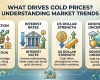
What Drives Gold Prices? Understanding Market Trends
 170
170  0
0  24
24

What Drives Gold Prices? A Beginner's Guide to Understanding the Gold Market
If you've spent any time watching the gold market, you've probably experienced this exact feeling: you check the price on Monday, it looks steady. You check again Thursday, and it's jumped $40 per ounce for no obvious reason. Then it drops again by the weekend.
What is going on?
The frustrating truth is that gold prices don't move randomly but they're also not controlled by any single person, government, or institution. The price of gold at any given moment is the result of several massive, interconnected global forces all pulling in different directions simultaneously.
Once you understand what those forces are, price movements start to make sense. You won't be able to predict every swing, but you'll stop feeling confused by the market and start reading it with genuine understanding.
This is Part 3 of the Gold Mastery Series. We've already covered the difference between 24K and 22K gold in Part 1, and the physical vs. digital gold debate in Part 2. Now we're going deeper into the economics and psychology behind gold pricing.
Force #1: Inflation Why Rising Prices Push Gold Higher
Let's start with the most fundamental driver of gold prices over the long term: inflation.
Inflation is the gradual increase in the price of goods and services over time, which is another way of saying that the purchasing power of your cash is slowly declining. The $100 bill you put in a drawer ten years ago will buy you noticeably less today than it did then. That's inflation at work.
Why Gold Responds to Inflation
Here's the key insight: gold doesn't earn interest. It doesn't pay dividends. It just sits there. So why would anyone hold it when cash is available?
Because while cash loses purchasing power over time, gold maintains it.
A classic example: in 1971, one ounce of gold cost approximately $35. At that same time, a tailored men's suit cost around $35. Fast forward to today one ounce of gold costs over $2,000, and a comparable tailored suit also costs roughly $1,500$2,000. The gold has tracked the real cost of the suit almost perfectly over 50 years. The dollar, meanwhile, would have lost the vast majority of its purchasing power if you'd simply kept it as cash.
The Inflation Trade
When inflation is running hot say, 6%, 7%, or 8% annually investors begin moving money out of cash and bonds (which are losing real value) and into assets that hold their worth. Gold is always at the top of that list.
This is exactly what happened in 2022. The US inflation rate hit a 40-year high of 9.1% in June 2022. In the months leading up to that peak, gold prices had surged significantly as investors positioned themselves against inflation eroding their purchasing power.
Practical takeaway: When you see central bank inflation reports or CPI (Consumer Price Index) data coming out higher than expected, pay attention. High or rising inflation is historically one of the most reliable signals for upward pressure on gold prices.
Force #2: The US Dollar The See-Saw Nobody Talks About
Gold is priced globally in US dollars. This single fact creates one of the most consistent and reliable relationships in all of finance: when the dollar goes up, gold tends to go down, and when the dollar weakens, gold tends to rise.
Why This Relationship Exists
If you're a European investor and gold costs $2,000 per ounce, the price you pay in euros depends on the exchange rate. If the dollar strengthens against the euro, gold effectively becomes more expensive for you so demand from non-US buyers falls, pulling prices down.
Conversely, when the dollar weakens, gold becomes cheaper in other currencies, demand rises globally, and prices are pushed upward.
The DXY Index Your Gold Price Early Warning System
Investors who follow gold closely watch something called the DXY Index the US Dollar Index. It measures the strength of the dollar against a basket of major currencies. You'll find it on any financial data website.
Historical example: From 2020 to early 2022, the Federal Reserve kept interest rates near zero and printed money aggressively to support the economy through COVID-19. This weakened the dollar significantly. Over that same period, gold prices surged from around $1,500 per ounce to nearly $2,100 a 40% gain directly correlating with dollar weakness.
Practical takeaway: If you see news about the Federal Reserve cutting interest rates or weakening economic data from the US, that often signals dollar softening ahead which is historically bullish for gold.
Force #3: Interest Rates The Invisible Hand on Gold Prices
Interest rates deserve their own section because they're one of the most actively traded variables that affects gold, and most beginners don't fully understand the connection.
Gold's Relationship With Rates
Here's the core logic: gold earns no yield. It pays no interest. When interest rates are high, safe investments like US Treasury bonds or savings accounts start paying 4%, 5%, even 6% annually. Suddenly, holding gold which pays nothing looks less attractive by comparison. Investors shift money into rate-bearing assets, and gold prices face downward pressure.
When interest rates are low or falling, the opposite happens. Bonds and savings accounts pay almost nothing. Gold's "zero yield" becomes a non-issue, and it starts looking very attractive again relative to its alternatives.
Real World Example
In 2022 and 2023, the Federal Reserve raised interest rates aggressively 11 times in 18 months to combat inflation. Despite high inflation (which normally supports gold), gold prices struggled to break above $2,000 consistently during this period because the high interest rates were pulling investor money into yield-bearing assets.
When the Fed signaled in late 2023 and 2024 that rate cuts were coming, gold immediately surged past $2,000 and eventually hit record highs above $2,400 in 2024 because investors were repositioning ahead of the lower-rate environment.
Practical takeaway: Watch Federal Reserve announcements closely. When rates are expected to fall, gold tends to benefit. When rates are rising, gold often faces short-term headwinds even if the long-term trend remains strong.
Force #4: Global Uncertainty Gold's Role as a Safe Haven
This one is less about economics and more about human psychology but human psychology moves trillions of dollars, so it matters enormously.
Why People Run to Gold During Crises
When markets are calm and economies are growing, investors are comfortable holding stocks, real estate, and other assets that carry risk. But when uncertainty spikes a war breaks out, a major bank fails, a pandemic shuts down the global economy the instinct to protect capital kicks in hard.
Gold has a 5,000-year track record of holding value through civilizational upheavals. No company can match that. No currency can match that. When everything feels unstable, gold feels permanent.
The Data Behind the Panic
- 2008 Financial Crisis: As major banks collapsed and global markets fell 4050%, gold rose from around $700 per ounce to over $1,900 by 2011 a 170% gain as investors fled to safety.
- COVID-19 Pandemic (2020): In the initial panic of March 2020, even gold dipped briefly as investors sold everything for cash. But within months, gold surged to a then-record $2,067 per ounce as the scale of economic disruption became clear.
- Russia-Ukraine War (2022): Within days of the invasion beginning in February 2022, gold jumped more than $200 per ounce in a matter of weeks as geopolitical risk spiked globally.
Practical takeaway: Major geopolitical events, banking sector stress, and stock market crashes are all historically followed by gold price spikes. If you already hold gold during these events, that's your position performing exactly as intended.
Force #5: Central Bank Buying The Biggest Player You Never Hear About
Individual investors and traders get a lot of attention in financial media. But the single largest driver of gold demand over the past decade has been something most beginners have never thought about: central banks.
What Central Banks Do With Gold
Central banks the government institutions that manage a country's money supply and foreign reserves hold gold as a reserve asset. It gives their currency credibility and provides a store of value that isn't subject to another country's monetary policy decisions.
In recent years, central banks globally have been buying gold at the fastest pace in decades. According to the World Gold Council, central banks purchased over 1,000 tonnes of gold in both 2022 and 2023 the highest levels recorded in over 50 years.
Why This Matters for Price
When institutions buying thousands of tonnes enter the market, they move prices. This sustained central bank demand has provided a strong floor under gold prices, explaining why gold has held up and continued rising even during periods when individual investor sentiment was mixed.
Countries like China, India, Poland, Turkey, and several Middle Eastern nations have been the most active buyers diversifying their reserves away from US dollar holdings. This trend shows no signs of reversing.
Practical takeaway: Central bank buying creates structural, long-term demand that supports gold prices regardless of short-term economic conditions. This is one of the reasons experienced investors remain confident in gold's long-term trajectory.
Force #6: Supply Constraints Why Mining Isn't Keeping Up
Unlike paper currency, which can be printed in unlimited quantities, gold is a finite physical resource. Mining new gold is expensive, time-consuming, and increasingly difficult as the most accessible deposits have already been extracted.
The Supply Reality
Global gold mining production has been relatively flat for years, hovering around 3,0003,500 tonnes per year. Meanwhile, demand from investors, central banks, jewelry buyers, and industrial users regularly exceeds that supply.
The time from discovering a new gold deposit to actually producing gold from it averages 1020 years. This means supply can't respond quickly to price increases the way manufacturing supply chains can. A jump in gold prices doesn't immediately produce more gold.
Jewelry Demand and Seasonal Patterns
Beyond investment demand, physical gold jewelry remains a massive market particularly in India and China, which together account for over 50% of global jewelry demand. In India, gold buying traditionally spikes during the wedding season (OctoberDecember) and festivals like Diwali and Dhanteras. In China, demand rises around the Lunar New Year.
These seasonal patterns create predictable demand surges that experienced gold investors factor into their timing decisions.
Practical takeaway: Gold supply is structurally constrained and can't be easily increased. Combined with growing demand from central banks and emerging market consumers, the long-term supply/demand balance continues to favor higher prices over time.
Putting It All Together: How to Read the Market
You now have six lenses through which to read gold price movements:
Inflation is rising Expect upward pressure on gold. Investors are protecting purchasing power.
US Dollar is weakening Expect upward pressure on gold. It becomes cheaper for non-dollar buyers.
Interest rates are falling Expect upward pressure on gold. Yield-bearing alternatives become less attractive.
Geopolitical crisis or market panic Expect sharp, short-term gold price spikes as safe-haven buying surges.
Central bank buying reports Sustained high buying supports long-term price floors.
Mining supply flat or declining Structural support for prices when demand remains strong.
These forces don't always all point in the same direction which is why gold prices still fluctuate daily. But when multiple factors align, the moves can be significant and sustained.
One Tool to Track It All in Real Time
Understanding what drives gold prices is one thing. Knowing the live value of the gold you actually own is another. Gold prices change every trading day, and a piece you bought three months ago might be worth meaningfully more or less today.
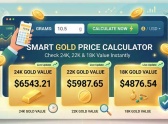
Our free calculator gives you an instant valuation of your gold holdings based on today's live market rates just enter the weight and purity:
Check Your Gold's Current Value with the Smart Gold Calculator
Have you noticed any of these forces at play in recent price movements? Whether you spotted a dollar dip, a Federal Reserve announcement, or a geopolitical event that moved prices, drop your observations in the comments below. The more you practice connecting the news to the price, the sharper your market instincts become.


















All comments, feedback, information or materials except email addresses submitted to Lush Wush shall be considered non-confidential and its property. By submitting such comments, feedback, information or materials to us, you agree to a no-charge assignment of all worldwide rights. For the best interest of the community, please refrain from posting vulgar comments, profanity, or personal attacks. Comments submitted may automatically be flagged for review by our moderation team before appearing on the website.