
How To Build An Emergency Fund Fast (even On A Low Income) - Part 2
 92
92  0
0  14
14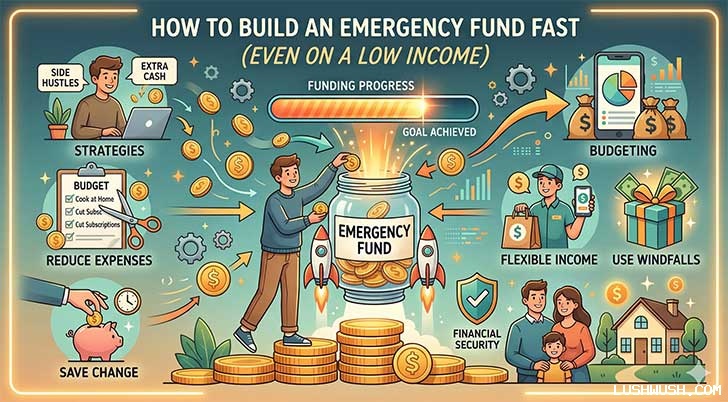

How to Build an Emergency Fund Fast: A Practical Guide for Every Income Level (Part 2)
Picture this: it's a Tuesday morning and your car won't start. Or your laptop dies two days before a major work deadline. Or you come home to a leak in the ceiling that needs an immediate repair.
In any of these situations, there are two kinds of people. The first type reaches for their phone, calls a mechanic or repair service, handles the situation, and gets on with their week. Stressful? Slightly. Catastrophic? Not even close.
The second type feels their stomach drop. They start mentally calculating whether they can afford the repair, which bill they can delay, whether to ask a family member for help, or whether to put it on a credit card that's already carrying a balance.
The difference between these two people isn't income. It's preparation. Specifically, it's whether they have an emergency fund.
This is Part 2 of our Smart Savings series. In Part 1, we covered the 50/30/20 budget rule and how allocating 20% of your income to savings can fundamentally change your financial trajectory. Today we're tackling the very first place that 20% should go before any investing, before any gold, before any stock market positions.
The emergency fund comes first. Here's why, and exactly how to build one.
Why an Emergency Fund Is the Foundation of Everything Else
Most personal finance content jumps straight to investing index funds, gold, real estate, compound interest. All of that is genuinely important. But investing before you have an emergency fund is like building the second floor of a house without finishing the first floor.
Here's what happens without an emergency fund:
You're one unexpected expense away from debt. The average unexpected car repair costs $500$1,500. A single ER visit without full insurance coverage can easily run $1,000$3,000. A broken essential appliance refrigerator, washing machine, water heater runs $300$1,000. Any of these expenses, appearing without warning, force you to either go into high-interest debt or liquidate investments at the worst possible time.
You can't invest with confidence. If you know that one bad month could force you to sell your investments to cover an emergency, you're never truly invested you're just temporarily holding assets that you might need to sell the moment life gets difficult. Markets often drop exactly when life gets harder. Selling at a loss during a crisis is the worst possible outcome.
Financial stress compounds all other stress. Research consistently shows that financial anxiety affects sleep, relationships, work performance, and physical health. An emergency fund doesn't just protect your money it protects your mental and physical wellbeing. That's not a soft benefit; it's a measurable one.
The emergency fund is the foundation. Everything else gets built on top of it.
How Much Do You Actually Need? (The Honest Answer)
The standard personal finance advice is "three to six months of living expenses." That's accurate as a long-term goal but for someone just starting out, hearing that number can feel paralyzing rather than motivating.
If your monthly expenses are $2,500 and you need six months saved, that's $15,000. That number feels impossible when you're starting from zero and saving $200 a month.
So let's talk about this more practically in stages.
Stage 1: The $500, $1,000 Starter Buffer
Your first emergency fund goal is not six months of expenses. It's $500 to $1,000.
This amount handles the vast majority of everyday financial emergencies a flat tire, a broken phone screen, an unexpected medical copay, a minor appliance repair. Research by the Urban Institute found that having even $250$750 in liquid savings dramatically reduces the likelihood of missing a bill payment or needing to take on debt after an unexpected expense.
This is your immediate target. Nothing else in the savings bucket until this is funded. Why this amount specifically? Because it's achievable in weeks to a few months for most people, and crossing that first milestone delivers real psychological momentum that makes the next stage feel possible.
Stage 2: One Month of Essential Expenses
Once your starter buffer is funded, expand it to cover one full month of your essential expenses rent, utilities, groceries, minimum debt payments, transportation. This is your Needs category from the 50/30/20 rule.
For someone with $2,000 in monthly essential expenses, this means building toward $2,000 total in the fund. That's meaningful protection against a short-term job disruption, a delayed paycheck, or a larger unexpected expense.
Stage 3: Three to Six Months of Expenses
This is the full, conventional emergency fund target. Where you land within that range depends on your personal situation:
Stick closer to three months if:
- You have a stable job with strong employment protections
- You have a dual-income household (two earners means lower overall vulnerability)
- You have other liquid assets you could access in a genuine worst case
Aim closer to six months if:
- Your income is variable freelance, commission-based, or seasonal
- You're the sole income earner for your household
- You work in an industry with higher job insecurity
- You have dependents who rely entirely on your income
The goal isn't a perfect number it's right-sizing your safety net for your actual life circumstances.
Where to Keep Your Emergency Fund: This Decision Matters More Than You Think
Location is one of the most underestimated decisions in emergency fund management. The wrong location either makes the money too easy to spend impulsively or too difficult to access when you genuinely need it.
The Wrong Places
Your main checking account: If your emergency fund lives alongside your grocery and entertainment money, it will quietly disappear. You'll spend it in small increments without realizing it, and when a real emergency hits, you'll find the account lower than expected.
Stock market investments or retirement accounts: Money in equities is not emergency savings. Markets can drop 3040% exactly when emergencies are most likely during economic downturns that also cause job losses. Selling investments at a loss to cover an emergency is precisely the outcome the fund is meant to prevent.
Locked accounts with withdrawal penalties: CDs with penalty clauses, fixed-term bonds, or any account that charges fees or requires advance notice for withdrawal. Emergency funds must be liquid accessible within one to two business days without cost.
The Right Place: A High-Yield Savings Account
A High-Yield Savings Account (HYSA) is the standard recommendation, and for good reason.
It's separate from your spending. Out of sight, out of mind. You won't see it sitting next to your checking balance, so you're not tempted to dip into it casually.
It earns meaningful interest. Traditional savings accounts at large banks currently pay 0.01%0.05% annually essentially zero. High-yield savings accounts at online banks have been paying 4%5% in recent years. Your emergency fund earning $200$500 per year in interest while sitting there is a meaningful bonus.
It's accessible when needed. Transfers from a HYSA to your checking account typically clear within one to two business days. For urgent situations, most banks also allow same-day transfers between linked accounts.
No penalties for withdrawal. Unlike CDs or investment accounts, you can access a HYSA at any time without fees or tax consequences.
Well-known HYSA options include Marcus by Goldman Sachs, Ally Bank, SoFi, and Capital One 360 but comparing current rates on a site like NerdWallet or Bankrate before opening is always worthwhile, since rates change.
One practical tip: When your bank issues a debit card for the savings account, don't carry it. Leave it at home. The minor friction of initiating a transfer and waiting a day is actually a feature it stops impulsive "emergencies" that aren't really emergencies.
How to Build It Fast: Practical Strategies for Every Income Level
Building an emergency fund purely from the 20% savings slice of your budget can feel slow. These strategies can meaningfully accelerate the timeline.
The Windfall Rule
Commit to directing a significant percentage 50% to 100% of every financial windfall into your emergency fund until it's fully funded. Windfalls include:
- Tax refunds (the average US federal refund is around $3,000)
- Work bonuses or overtime pay
- Birthday or holiday money received as cash gifts
- Selling items you no longer use
- Any unexpected additional income
A single tax refund can fully fund a Stage 1 starter buffer in one move.
The Spending Audit Method
Pull up your last two to three months of bank and credit card statements and look for spending that you genuinely wouldn't miss:
- Subscriptions you forgot you were paying for
- Services you're paying full price for that have cheaper alternatives
- Takeout and dining expenses that have crept up beyond your expectations
- Recurring charges for things you no longer use
Even finding $60$100 per month in spending you don't miss adds $720$1,200 per year to your effective savings rate without changing how your daily life feels.
The Round-Up Method
Several banking apps offer automatic round-up features: every purchase is rounded up to the nearest dollar, and the difference is transferred to savings. Buying a $4.30 coffee rounds up to $5, with $0.70 going to savings. Over hundreds of monthly transactions, this passively accumulates $20$60 per month with no conscious effort.
Apps like Acorns and Chime do this automatically, and many traditional banks have built similar features into their apps.
The Temporary Budget Tightening
If you want to reach your Stage 1 goal within 6090 days rather than gradually over six months, consider temporarily shifting from 50/30/20 to 50/20/30 increasing savings from 20% to 30% by trimming the wants allocation for one quarter.
At $3,000/month after-tax income, that's an additional $300/month directed to savings. In 90 days, you've added $900 enough to fully fund a starter buffer and then you return to your normal allocation. The sacrifice is temporary. The protection is permanent.
The "Is It Actually an Emergency?" Test
Once your emergency fund exists, you'll face a recurring temptation: using it for things that feel urgent but aren't genuine emergencies.
A sale at your favorite store is not an emergency. A concert that just announced tickets is not an emergency. A spontaneous weekend trip that wasn't budgeted is not an emergency.
Before transferring anything from your emergency fund, run it through this three-question test:
Question 1: Is it completely unexpected? Something you could have planned or budgeted for in advance doesn't qualify. Annual car registration, upcoming holiday gifts, and back-to-school expenses are all predictable they belong in your regular monthly budget, not your emergency fund.
Question 2: Is it genuinely necessary? Would real harm occur to your health, your ability to work, or your core financial obligations if this goes unpaid this week? A broken furnace in winter is necessary. New shoes are not.
Question 3: Is it urgent? Does it need to be handled within days, not weeks? Something that can wait three to four weeks while you save up doesn't meet the urgency threshold.
If all three answers are yes unexpected, necessary, and urgent use the fund without guilt. That is precisely what it is for.
And when the emergency has passed, you simply resume your savings plan and rebuild the fund before directing any money toward other financial goals.
The Refill Rule: What to Do After You Use It
Using your emergency fund during a real emergency is not a failure it's the system working exactly as designed. But one rule applies immediately after:
Rebuilding the fund takes priority over everything else until it's restored.
Any investing, extra debt payments beyond minimums, and savings goals other than the emergency fund go on temporary pause until you're back to your target balance. This usually doesn't take long if the fund was only partially depleted and the temporary interruption is a small price for the financial security the fund provided.
What Comes After the Emergency Fund?
Once your emergency fund reaches your target whether that's one month or six months of expenses your 20% savings allocation shifts to the next priority.
This is where long-term wealth building begins: clearing high-interest debt aggressively, contributing to retirement accounts, investing in index funds, building positions in gold or other assets, and compounding your way toward genuine financial freedom.
The emergency fund isn't the destination. It's the launch pad.
In Part 3 of this series, we'll map out exactly where your money should go once the emergency fund is in place the order of financial priorities that maximizes long-term wealth while minimizing risk at every stage.
Where are you in building your emergency fund right now? Just getting started, halfway there, or already fully funded? Drop your current stage in the comments and share any strategies that worked for you that aren't in this article.
















All comments, feedback, information or materials except email addresses submitted to Lush Wush shall be considered non-confidential and its property. By submitting such comments, feedback, information or materials to us, you agree to a no-charge assignment of all worldwide rights. For the best interest of the community, please refrain from posting vulgar comments, profanity, or personal attacks. Comments submitted may automatically be flagged for review by our moderation team before appearing on the website.