
Smart Emi And Interest Calculator Reveal The True Cost Of Your Loan
 127
127  0
0  15
15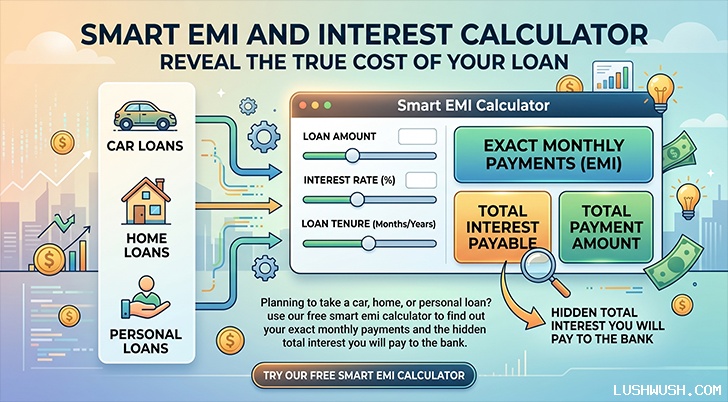

Smart EMI & Interest Calculator: Find Out What Your Loan Really Costs
The $1,673 Payment That Looked Fine on Paper
Hassan sat across from his loan officer, who slid a number across the desk: $1,673 a month for a $200,000 home loan at 8% over 20 years. It sounded manageable less than what he was paying in rent, honestly. He signed without asking a second question.
Ten years later exactly halfway through the loan Hassan pulled up his amortization schedule out of curiosity. He'd made 120 payments by then, totaling $200,760. More than the entire amount he'd originally borrowed. He expected to see roughly half the loan paid off.
Instead, he still owed $137,878. Only about $62,000 of that decade of payments had actually reduced what he owed. The other $138,600 or so had gone straight to the bank as interest, on a loan he thought he'd understood perfectly well the day he signed it.
Hassan wasn't a careless borrower. He's exactly like most people: he looked at the one number the bank showed him the monthly payment and never asked the much bigger question hiding behind it.
Why Banks Show You One Number (And It's Not the Important One)
When you take a loan, you're not just borrowing money you're renting it, and the rental fee is interest. The problem is that the monthly payment, the number every lender leads with, tells you almost nothing about that fee. $1,673 a month sounds like a fixed, predictable cost. What it hides is that over 20 years, that "predictable" payment adds up to $401,520 total on a $200,000 loan meaning $201,520 in pure interest, or just over a dollar of interest for every dollar borrowed.
That extra $201,520 isn't a fee you were told about clearly upfront. It's the number that only shows up if you actually multiply the payment by the number of months, which almost nobody does at the closing table.
How Your EMI Actually Works: Interest vs. Principal
EMI stands for Equated Monthly Installment the fixed amount you pay every month. But that fixed number splits into two very different pieces every single time: interest, which goes straight to the bank as profit, and principal, which is the only part that actually reduces what you owe.
Why the Early Years Are Interest-Heavy
On Hassan's loan, his very first $1,673 payment broke down to roughly $1,333 in interest and only $340 in principal meaning about 80% of that first payment did nothing but pay the bank's fee, and just 20% actually chipped away at the debt. That's not a rounding error or a bad deal specifically for Hassan; it's simply how amortized loans are structured everywhere. Interest is calculated on whatever balance remains, and early on, almost the entire balance still remains.
When the Balance Finally Flips
The ratio does shift over time, but slower than most people expect. On Hassan's loan, the interest and principal portions of his payment don't reach roughly 50/50 until close to year 13 of the 20-year term. This is exactly why paying off a loan even a few years early saves so disproportionately much you're skipping the years where your payment is still mostly funding the bank's profit, not your equity.
How to Use the Smart EMI & Interest Calculator
Instead of guessing or trusting the one number a loan officer leads with, you can see the real breakdown in seconds. Enter three things:
- How much you want to borrow your loan principal
- The interest rate the bank is charging ideally confirmed as reducing balance, not flat (more on that shortly)
- How long you want to take to pay it back your loan term in months or years
And instantly, you see the full picture: not just the monthly payment, but the total amount you'll actually hand over by the time the loan is paid off.
Why the Visual Bar Matters: Blue vs. Red
The stacked bar chart at the bottom of the Smart EMI & Interest Calculator splits your total repayment into two colors. The blue section is your principal the actual money you borrowed. The red section is pure interest the extra money leaving your pocket for the privilege of borrowing.
On Hassan's loan, that red section ends up larger than the blue one: $201,520 in interest against $200,000 in principal. When the red section outgrows the blue section, that's your signal that you're paying more in interest than you originally borrowed and it's exactly the kind of thing a monthly payment number alone will never show you.
Try adjusting the loan duration slider and watch the red section shrink. That visual shift, more than any explanation, is what makes people actually reconsider a longer loan term "for a smaller payment."
Real Numbers: What a $200,000 Loan at 8% Actually Costs
Let's lay Hassan's full numbers out plainly, since seeing them together is more useful than any single figure on its own:
- Amount borrowed: $200,000
- Interest rate: 8% (reducing balance)
- Term: 20 years (240 monthly payments)
- Monthly payment: $1,673
- Total paid over the full term: $401,520
- Total interest paid: $201,520
- Paid at the 10-year mark (halfway through the term): $200,760 total payments made
- Balance still owed at that same 10-year mark: $137,878
- Actual principal reduced in that first decade: just $62,000
That last pair of numbers is the one worth sitting with. A full decade of consistent, on-time payments, totaling more than the original loan amount, and Hassan still owed nearly 69% of what he originally borrowed.
Three Ways to Actually Pay Less Interest
Shorten the Loan Term
A longer loan means a smaller monthly payment, which is exactly why a 7-year car loan looks more appealing on paper than a 3-year one. But that extra time comes at a real cost, and even a modest reduction in term makes a measurable difference the earlier example already showed how dramatically the interest-heavy years stack up, so shaving even a couple of years off a term compounds into real savings. Choose the shortest timeline you can actually sustain without breaking your monthly budget.
Make Extra Principal Payments
This is the lever most borrowers never use. Whenever you get a bonus, a tax refund, or extra cash, put it directly toward the principal, not future payments.
Take Hassan's loan again: if he made one extra $5,000 payment at the end of his first year on top of his regular schedule that single payment would cut roughly 13 months off his remaining loan term and save him approximately $16,700 in total interest, all from one payment made early, while the loan still had most of its interest-heavy years ahead of it. The earlier in the loan you do this, the more it's worth, because you're removing that $5,000 from being charged interest for nearly two more decades instead of just a few years.
Choose Reducing Balance Over Flat Rate
Some lenders offer "flat rate" interest, which sounds simple but is genuinely a trap. With a flat rate, interest is calculated on the original loan amount for the entire term, even as you're paying the balance down. A "reducing balance" rate only charges interest on what you still actually owe which is always the better deal for the same stated percentage.
Here's how big that gap really is: a $10,000 loan over 3 years at a "10% flat rate" works out to a monthly payment of about $361. Solve for what reducing-balance rate would produce that exact same payment, and the answer comes out to roughly 18% on a reducing balance basis nearly double the rate the loan was marketed under. Always ask your lender explicitly which type you're being quoted, because the label alone can hide a rate that's twice as expensive as it sounds.
Common Mistakes People Make When Taking a Loan (What NOT to Do)
- Fixating only on the monthly payment without ever asking what the total repayment adds up to over the full term
- Assuming a "flat rate" is the same as a comparable reducing-balance rate, when it can actually be worth close to double
- Choosing the longest available term automatically to get the smallest payment, without weighing how many extra years of interest that adds
- Never making extra principal payments, even when bonuses or windfalls are available, leaving thousands of dollars in avoidable interest on the table
- Not confirming whether early repayment carries a penalty before assuming you can pay ahead freely
- Comparing loans purely by advertised interest rate without checking fees, insurance add-ons, or processing charges that change the real cost
- Signing the same day you're quoted a number, without running the total cost through a calculator first
Your Practical Action Plan Before You Sign Any Loan
- Get the exact principal, rate, and term in writing before agreeing to anything
- Run those three numbers through the Smart EMI & Interest Calculator to see total interest, not just the monthly payment
- Confirm explicitly whether the rate is flat or reducing balance ask directly, since it's rarely volunteered
- Compare at least two loan term options side by side to see the real trade-off between payment size and total interest
- Ask whether extra or early payments carry any penalty, so you know your options in advance rather than finding out later
- Plan where windfalls will go before they arrive deciding in advance to direct bonuses toward principal makes it much more likely you'll actually do it
- Only sign once the total cost, not just the monthly number, feels genuinely worth it
This is general financial education, not personalized lending advice actual rates, terms, and penalty structures vary by lender and region, so confirm the specific details of any offer directly with your bank or loan officer before signing.
Beginner FAQ: EMI and Loan Interest
Why does so little of my early payments go toward the actual loan balance? Because interest is calculated each month on whatever balance still remains, and early in a loan, almost the full amount still remains. As the balance slowly shrinks, the interest portion of each payment shrinks with it, and the principal portion grows but that shift takes years, not months, especially on longer-term loans.
Is it always better to choose the shortest loan term I can afford? Generally, yes, from a pure total-interest standpoint shorter terms consistently mean less total interest paid. The caveat is "afford": a term so short that it strains your monthly budget isn't actually the better choice if it risks missed payments or leaves no room for emergencies. The right term is the shortest one that still leaves your budget genuinely comfortable.
Will my lender let me make extra payments without a penalty? It depends entirely on the lender and loan type, and this varies enough that it's worth asking directly rather than assuming. Some loans allow unlimited extra principal payments with no penalty; others charge a prepayment fee specifically to discourage paying off the loan early, since that reduces the total interest they collect.
What's the difference between "interest rate" and APR? The interest rate is just the cost of borrowing the principal itself. APR (annual percentage rate) is meant to reflect the interest rate plus most other mandatory fees, rolled into a single annualized number which is generally the more accurate figure to use when comparing two different loan offers side by side.
Does refinancing to a lower rate always save money? Not automatically. A lower rate genuinely can reduce your total interest, but refinancing usually resets your amortization schedule back to the interest-heavy early years, and often comes with its own closing costs or fees. Before refinancing, it's worth running both the new and old loan through a calculator to compare total remaining cost, not just the headline rate a lower rate on a loan you restart from year one can sometimes cost more overall than finishing out a slightly higher-rate loan you're already partway through.
Hassan's loan wasn't a bad decision. A home loan is often exactly the kind of good debt worth taking on. What was missing wasn't the loan itself it was the thirty seconds of math that would have shown him the total cost before he signed, and the extra-payment strategy that could have saved him thousands once the loan was already underway. Loans aren't the enemy. Signing one without knowing the real number is.
Before you sign anything a home, a car, a business loan spend 30 seconds with our free Smart EMI & Interest Calculator and see the real total cost, not just the monthly payment the bank leads with.


















All comments, feedback, information or materials except email addresses submitted to Lush Wush shall be considered non-confidential and its property. By submitting such comments, feedback, information or materials to us, you agree to a no-charge assignment of all worldwide rights. For the best interest of the community, please refrain from posting vulgar comments, profanity, or personal attacks. Comments submitted may automatically be flagged for review by our moderation team before appearing on the website.