
Personal Loan Vs Credit Card: Which One Actually Costs You Less?
 127
127  0
0  16
16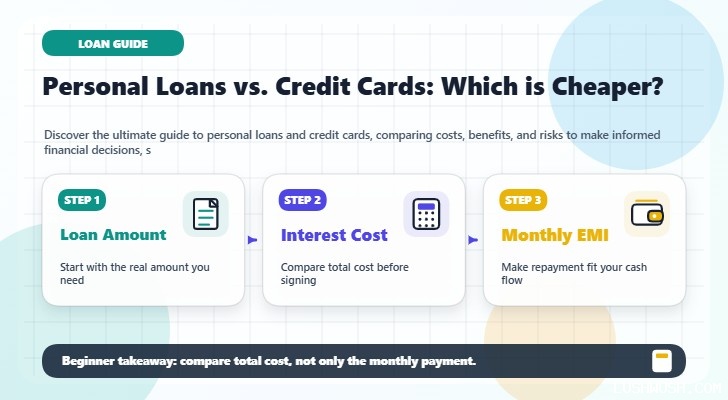

Personal Loan vs Credit Card: Which One Actually Costs You Less?
The $10,000 Question: Same Money, Wildly Different Total Cost
You need $10,000. Maybe it's an unexpected medical bill, a home repair that can't wait, or a large purchase you'd rather spread out over time. Whatever the reason, two options are sitting in front of you: take out a personal loan, or put it on a credit card.
Both get you the money today. Here's what they don't tell you upfront: choosing between them can mean the difference between paying back roughly $11,525 total, or roughly $18,800 total, for borrowing the exact same $10,000. Same need, same amount, a $7,275 gap depending entirely on which option you picked and how you paid it back.
Both routes work. They just work very differently, and understanding exactly how is worth the ten minutes it takes to read this.
How a Personal Loan Actually Works
A personal loan is straightforward: you apply for a fixed amount, get approved, receive the money, and repay it in equal monthly installments over an agreed period typically 1 to 5 years. The interest rate is fixed, so your payment stays identical from the first month to the last. No surprises, no fluctuating balances.
That fixed structure is a feature, not a limitation you know exactly how much you owe, exactly what you'll pay monthly, and exactly when it ends. Personal loans typically carry interest rates between 10% and 24% annually, depending on your credit history and lender, and some banks charge an upfront processing fee, usually 1% to 3% of the loan amount, worth factoring into any real comparison.
How a Credit Card Actually Works
A credit card gives you a spending limit say $5,000 or $10,000 that you can draw on whenever you want. Each month, you get a bill, and here's the part that matters: you can pay the full balance, or pay a smaller minimum and carry the rest forward.
That flexibility is genuinely convenient, right up until the moment it isn't. Credit card interest rates are typically much higher than personal loans, often ranging from 24% to 42% annually, and interest isn't calculated on what you originally spent it's recalculated every month on whatever balance you're still carrying. If you only make minimum-ish payments, a balance that felt manageable can take years to clear and cost nearly double the original amount in interest. That's not a rare worst case. It's a very common one.
The Real Comparison: What Does Each One Actually Cost?
Let's use real numbers instead of leaving this abstract.
The Personal Loan Path
Borrow $10,000 at 14% interest over 2 years: your monthly payment works out to roughly $480. Total paid back over the full term: roughly $11,525. Total interest paid: roughly $1,525.
The Credit Card Minimum-Payment Path
Carry that same $10,000 on a credit card at 36% APR (3% monthly), paying a fixed $400 a month a realistic stand-in for a "minimum-ish" payment on a balance this size. That $400/month takes roughly 47 months (just under 4 years) to clear the balance entirely. Total paid: roughly $18,800. Total interest: roughly $8,800.
Same $10,000 borrowed. Nearly 6 times more in interest, and almost double the total repayment, purely from the path chosen. This is exactly why the answer to "which is cheaper?" is almost always the same: for any significant amount you can't clear within one billing cycle, a personal loan wins by a wide margin.
So When Does a Credit Card Actually Make Sense?
Credit cards aren't the villain here used correctly, they're genuinely useful. A card makes sense when you can pay the full balance before the due date: spend $2,000 this month, pay it off completely when the bill arrives, and you've paid zero interest possibly while earning rewards or cashback in the process. That's a legitimate win, not a trap.
Cards are also well-suited to smaller, everyday purchases groceries, fuel, subscriptions where you already have the money and you're using the card purely for convenience and rewards tracking. The expense arrives the moment you start carrying a balance instead of paying in full; that's when the 24-42% rate actually starts working against you.
When a Personal Loan Makes More Sense
Choose a personal loan when the amount is significant anything beyond what you can comfortably clear in one or two billing cycles is better handled as a structured loan with fixed, predictable payments.
Debt Consolidation The Smartest Use Case
This is genuinely one of the smartest applications of a personal loan. Say you're carrying $20,000 across multiple credit cards at 36% APR, paying roughly $800/month toward them. Left on that path, it takes about 47 months and roughly $17,520 in total interest to clear.
Consolidate that same $20,000 into a personal loan at 14% over 3 years instead, and the numbers flip dramatically: your monthly payment actually drops to roughly $684, and total interest falls to roughly $4,611 a savings of about $12,909, while paying less each month, not more. You go from scattered and expensive to structured and cheap, simultaneously.
Large, Planned, One-Time Expenses
Medical expenses, education costs, home repairs, a wedding for big, planned expenses, a personal loan gives you a clear, finite repayment path rather than an open-ended balance that can quietly grow if a month gets tight.
The One Thing Most People Get Wrong: Monthly Payment vs. Total Cost
Most people compare these two options based on monthly payment size alone: "the credit card minimum is lower than the loan EMI, so the card feels easier." That thinking is the actual trap.
A lower minimum payment doesn't mean lower cost it usually means you're covering less principal and more interest each month, stretched over a much longer period. The number that actually matters is total repayment, and as the math above shows, it's almost always dramatically higher with a credit card once you're carrying a balance rather than paying in full.
What Happens If You Miss a Payment on Each
Missing a payment carries real consequences on both sides, though the mechanics differ. Miss a personal loan payment, and you'll typically face a late fee often $25-$50 or a percentage of the payment plus a potential credit score hit once the payment is 30+ days overdue. The interest rate on the loan itself, though, usually stays fixed regardless.
Miss a credit card payment, and beyond a similar late fee, many issuers can trigger a penalty APR sometimes pushing your rate well above the already-steep 24-42% range, in some cases toward 29-35%+ specifically as a penalty. That elevated rate can apply to your existing balance too, not just new charges, and depending on the card's terms, may stick around for six or more months of consistent on-time payments before reverting to normal. This is exactly why a credit card balance under financial stress can spiral faster than a personal loan balance facing the same missed payment the loan's structure absorbs the hit more predictably.
Common Mistakes People Make Choosing Between the Two (What NOT to Do)
- Comparing monthly payment size instead of total cost, exactly the trap described above
- Assuming the credit card minimum payment is fixed and stable, when it typically shrinks as the balance does, stretching payoff time out even further than expected
- Taking out a personal loan for a small, short-term purchase that could have been paid off interest-free on a card within one billing cycle
- Consolidating credit card debt into a personal loan, then continuing to charge the same cards, defeating the entire purpose and ending up with both a loan payment and new card debt
- Ignoring processing fees on personal loans when comparing total cost against a card, since a 1-3% upfront fee genuinely affects the real number
- Not shopping around across multiple lenders, when personal loan rates can swing from 10% to 24% depending entirely on credit profile and lender
- Closing every consolidated credit card immediately after payoff, which can sometimes affect credit utilization and account history length worth understanding before acting reflexively
Your Practical Action Plan Before You Borrow
Before signing anything, run through this sequence it takes less time than the loan application itself, and it's the difference between the $11,525 outcome and the $18,800 one from the example above.
- Determine if the amount is "pay in full this month" size or "needs real time" size that distinction alone points you toward the right tool
- If it's a card purchase you can pay in full by the due date, use the card and treat any rewards as a genuine bonus
- If it'll take more than one or two billing cycles, compare total repayment amounts, not monthly payments, before deciding
- Shop personal loan rates across at least 2-3 lenders, including any processing fees in your comparison, not just the headline interest rate
- If consolidating existing card debt, run the exact numbers before committing rather than assuming consolidation is automatically cheaper
- Set a concrete plan to avoid re-accumulating card balances after consolidating, since that's the single most common way consolidation backfires
- Run any loan or card scenario through a calculator before signing anything, so the total cost is a known number, not a surprise six months in
Beginner FAQ: Personal Loan vs. Credit Card
Does taking a personal loan hurt my credit score? There's often a small, temporary dip from the hard credit inquiry and the new account, but responsibly managing a personal loan including using one to consolidate higher-interest card debt can improve your credit profile over time by lowering your credit utilization and demonstrating consistent on-time payments.
What credit score do I need to get a good personal loan rate? It varies by lender, but generally, stronger credit scores unlock rates toward the lower end of the 10-24% range, while weaker credit profiles see rates toward the higher end or may struggle with approval altogether. Checking your score before applying gives you a realistic sense of where you'll likely land.
Can I pay off a personal loan early without penalty? This depends entirely on the specific lender and loan agreement some allow early payoff with no penalty, while others charge a prepayment fee specifically to recoup some of the interest they'd otherwise have collected. Always confirm this detail before signing, not after you're ready to pay it off.
Is it ever smart to use a credit card even if I can't pay it off immediately? Occasionally, yes some cards offer a genuine 0% introductory APR period on purchases or balance transfers, which can function similarly to an interest-free short-term loan if you have a concrete plan to pay it off before the promotional period ends. Outside of a specific promotional window like that, carrying a balance at the standard 24-42% rate rarely makes sense compared to a personal loan for any significant amount.
What about a balance transfer card instead of a personal loan for consolidating debt? A 0% introductory balance transfer card can genuinely beat a personal loan's interest rate during the promotional window, often 12-21 months, sometimes with a small one-time transfer fee (commonly 3-5% of the transferred amount). The risk is what happens after the promotion ends any remaining balance typically reverts to a standard high credit card rate, so this option only wins if you have a realistic plan to clear the balance before that window closes, whereas a personal loan's fixed rate holds for the entire term regardless.
The $7,275 gap between these two paths for the exact same $10,000 wasn't caused by bad luck or a hidden fee nobody could have seen coming. It came from comparing the wrong number monthly payment instead of total cost which is an easy mistake to make and an even easier one to avoid once you know to look for it.
Whatever you decide personal loan or credit card see the real breakdown before you commit. Use our free Smart EMI & Interest Calculator to see exactly what you'll pay in total, how much goes to interest versus principal, and how the term length changes the final number, before you sign anything.














All comments, feedback, information or materials except email addresses submitted to Lush Wush shall be considered non-confidential and its property. By submitting such comments, feedback, information or materials to us, you agree to a no-charge assignment of all worldwide rights. For the best interest of the community, please refrain from posting vulgar comments, profanity, or personal attacks. Comments submitted may automatically be flagged for review by our moderation team before appearing on the website.